

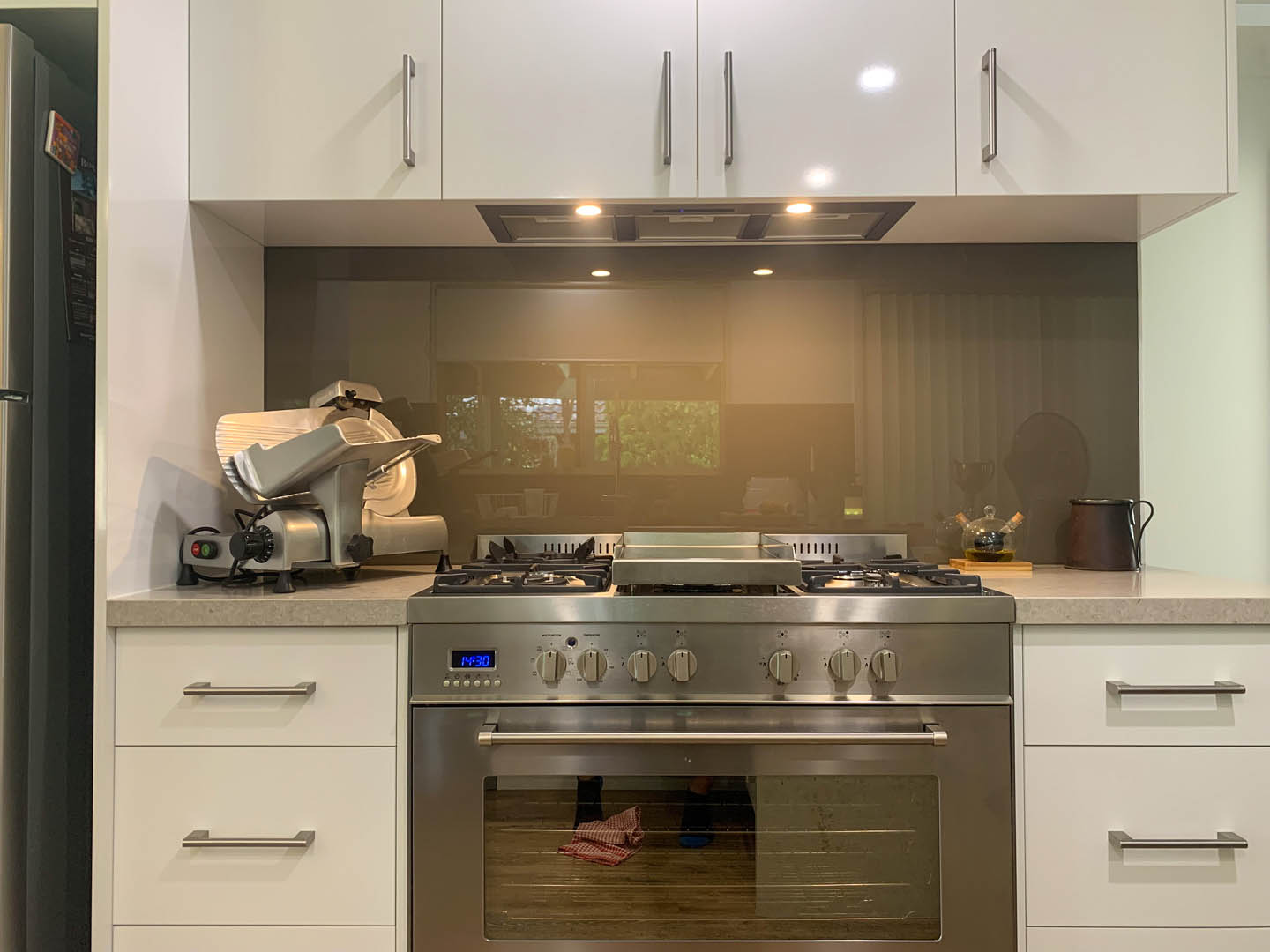
If you’ve been Googling glass splashbacks in Sydney, you’re probably in one of two camps: you’re a homeowner staring at a tired, grout-stained tiled wall behind your stove and wondering if there’s a better way — or you’re a kitchen designer or builder who wants to spec something that clients will genuinely rave about for years. Either way, you’re in the right place.
Glass splashbacks have quietly become one of the most popular upgrade choices in Sydney homes, and once you understand why, it’s hard to argue with the logic. They’re sleek, incredibly easy to clean, heat resistant, and they can completely transform the feel of a kitchen or bathroom without a full renovation. But not all glass splashbacks are created equal — and in a market as competitive as Sydney’s, knowing what to look for (and who to trust) makes all the difference.
In this guide, we’re covering everything: what glass splashbacks actually are, why they work so well in Australian homes, how they stack up against other materials, and what makes Shine Glass the go-to choice for glass splashbacks across Sydney. By the time you finish reading, you’ll have a clear picture of whether glass is the right move for your space — and exactly what your next step should be.
What Are Glass Splashbacks?
A glass splashback is exactly what it sounds like — a panel of glass installed on a wall surface, typically behind a kitchen cooktop, sink, or bathroom basin. Unlike a collection of individual tiles, a splashback is a single, seamless sheet (or a series of precisely joined panels) that sits flush against the wall and creates a smooth, continuous surface.
In Australia, most glass splashbacks are made from toughened (tempered) safety glass, which is the same kind of glass used in car windshields and shower screens. The glass is cut to measure, toughened in a high-temperature furnace, and then either painted on the back (known as back-painted glass) or digitally printed with a custom image or pattern before installation. The result is a surface that’s hard, smooth, reflective, and — crucially — has no grout lines for bacteria or grime to hide in.
You’ll find glass splashbacks in kitchens, bathrooms, laundries, and even butler’s pantries across Sydney. They’re equally at home in a Paddington terrace undergoing a heritage-sensitive reno as they are in a brand-new apartment build in Parramatta or a coastal kitchen on the Northern Beaches. Their versatility is a big part of their appeal.
Back-Painted vs. Printed Glass Splashbacks
The two most common types you’ll encounter in Sydney are:
- Back-painted glass: The underside of the glass is painted with a specialised paint in your chosen colour before toughening. Because you’re looking through the glass at the paint, the colour appears rich, deep, and almost luminous — a quality flat paint on a wall simply can’t replicate.
- Digitally printed glass: A high-resolution image — a marble look, a botanical print, a coastal scene, whatever fits your vision — is printed directly onto the glass. This opens up an almost limitless range of design possibilities for homeowners who want something genuinely unique.
Both options are available in toughened safety glass, and both can be installed behind gas or electric cooktops with the appropriate clearances followed (more on that under durability). If you want to explore the full range of glass types and finishes available, the team at Shine Glass can walk you through your options and help you find the right fit for your space.
What Purpose Do They Serve?
There’s a very practical answer and a slightly more aspirational one here — and honestly, both matter equally.
The Practical Purpose: Protection
At its most functional, a splashback exists to protect your walls from moisture, grease, food splatter, and steam. In a kitchen, the zone behind your cooktop and sink takes a real battering on a daily basis. Without a splashback, you’re looking at paint that stains, walls that absorb moisture, and — in older Sydney homes — plaster that can deteriorate over time.
Glass handles all of that without breaking a sweat. Grease doesn’t soak in. Steam doesn’t cause warping. A quick wipe with a damp cloth and a little white vinegar, and your splashback looks exactly the same as the day it was installed. For busy Sydney families and high-use commercial kitchens alike, that low-maintenance quality is genuinely valuable.
The Hygiene Factor
This one is especially worth calling out: glass splashbacks are non-porous. There are no grout lines, no micro-cracks, and no rough surfaces where food particles, mould spores, or bacteria can accumulate. It’s one of the reasons glass splashbacks are used extensively in professional and commercial food preparation environments — hygiene compliance is significantly easier to maintain. For Australian homeowners who care about food-safe environments (and who’s cleaning their kitchen), this matters.
The Aspirational Purpose: Design
Beyond the practicalities, a glass splashback does something that painted walls and tiled surfaces rarely do — it elevates the entire look and feel of a space. The reflective quality of glass bounces light around the room, making smaller kitchens feel larger and darker spaces feel brighter. In a Sydney apartment where natural light can be at a premium, that’s a meaningful design benefit.
Trade Professional Tip: When speccing a glass splashback for a client, always consider the wall colour and cabinetry finish together. A well-chosen splashback colour can act as the visual anchor for the whole kitchen — pulling together bench tones, hardware finishes, and paint colours in a way that tiles rarely do.
Sleek and Contemporary Design
Walk through any award-winning kitchen renovation on the Northern Beaches, Mosman, or the inner west, and there’s a solid chance a glass splashback is a feature. They’ve become shorthand for modern, considered kitchen design in Sydney — and for good reason.
The defining visual quality of a glass splashback is its seamlessness. There are no grout joints interrupting the visual field, no pattern repeats to align, and no edges to worry about (when installed correctly). The result is a clean, unbroken surface that makes a kitchen feel resolved — like it was designed with intention rather than assembled from off-the-shelf components.
Colour Options: Essentially Limitless
One of the questions we hear most often is: “Can I get the glass matched to my kitchen colour scheme?” The answer is yes — and it’s easier than most people expect. Back-painted glass can be produced in virtually any colour, including custom-matched finishes if you have a specific paint swatch or Dulux/Taubmans code in mind.
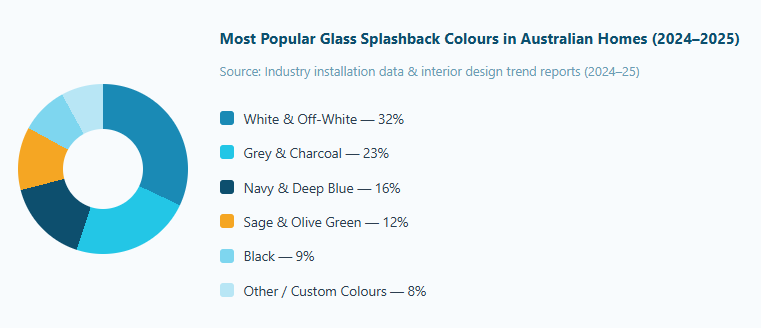
Neutral tones like white, off-white, and light grey continue to dominate in Sydney kitchens because they’re endlessly adaptable — they work with timber cabinetry, stone benchtops, and both warm and cool hardware finishes. But we’re also seeing a strong shift toward deeper, more characterful colours: forest green, navy, and even matte black splashbacks are becoming increasingly popular in inner-city Sydney homes where the kitchen is very deliberately a design statement.
Design Flexibility for Architects and Designers
For kitchen designers and architects speccing glass splashbacks for Sydney projects, the flexibility goes well beyond colour. Glass can be cut to fit any wall configuration — around windows, power points, range hoods, and extract fans. Unlike tiles, there’s no need to work around a standard module size. And because the surface is smooth and continuous, it photographs exceptionally well (which matters increasingly in an era where clients share their renovations on Instagram).
Styling Tip: If your Sydney kitchen gets good natural light, consider a slightly off-white or warm white splashback rather than a stark bright white. Under direct sunlight, warm whites feel luxurious; bright whites can read as clinical. Bring a physical glass sample home and hold it against your cabinetry before committing.
Durability and Heat Resistance
This is probably the section most homeowners want to skip straight to — and understandably so. You’re investing in a permanent fixture in your home. You want to know it’ll last.
Toughened Safety Glass: How Strong Is It Really?
The short answer is: very. Toughened (tempered) glass used in splashbacks is processed through a controlled thermal or chemical treatment that makes it approximately four to five times stronger than standard annealed glass of the same thickness. When toughened glass does break — and it can, under a very significant direct impact — it crumbles into small, relatively harmless fragments rather than large, dangerous shards. That safety characteristic is a key reason it’s the mandated choice for kitchen and bathroom installations in Australia.
For kitchen use, glass splashbacks are typically supplied in 4mm to 6mm toughened glass, with 6mm being the standard recommendation for most residential installations. Thicker profiles are available for commercial applications.
Heat Resistance: What You Need to Know
This is the question that comes up constantly, and it’s worth being straightforward about: toughened glass is heat resistant, but it does have limits — and those limits are governed by Australian Standards and manufacturer guidelines.
- Electric cooktops: Glass splashbacks can generally be installed directly behind electric cooktops without any special clearance requirements, provided the installation complies with AS/NZS 4386.
- Gas cooktops: The Australian Standard AS 5601 (Gas Installations) specifies that a non-combustible surface (which toughened glass qualifies as) must be maintained behind gas burners, but a minimum clearance of 200mm from the edge of the burner to the face of the glass is recommended by most manufacturers and installers to prevent thermal stress cracking from repeated heat cycling.
- Induction cooktops: Because induction only heats the cookware — not the surrounding surface — there are no heat-related clearance concerns with a glass splashback behind an induction cooktop.
Important: Always have your glass splashback installed by a qualified professional who is familiar with the relevant Australian Standards. Incorrect installation — particularly with gas cooktops — can void your warranty and create a safety risk. The team at Shine Glass handles all installations in compliance with Australian Standards.
How Long Will a Glass Splashback Last?
Barring an extreme impact event, a properly installed and maintained glass splashback will last the lifetime of the kitchen. There’s no grout to regrout, no surface to reseal, and no colour to fade (because the paint is on the back of the glass, protected from UV and abrasion). Many Sydney homeowners who installed glass splashbacks a decade ago report they look as good today as they did on day one.
How Glass Splashbacks Increase the Appeal of Your Home
Sydney’s property market is well known for being intensely competitive, and buyers — whether they’re purchasing a home or an investment property — pay attention to the kitchen and bathroom more than almost any other room in the house. These are the spaces that influence purchasing decisions, rental expectations, and how a property presents at inspection.
First Impressions in the Kitchen
Real estate agents consistently identify the kitchen as one of the highest-impact rooms in a property — a well-presented kitchen can meaningfully improve buyer perception and justify a higher asking price. A glass splashback contributes to that impression in several concrete ways:
- The seamless surface looks premium and contemporary, signalling quality to potential buyers.
- The reflective quality of glass bounces light around the room, making it appear larger and more inviting in photographs (where most Sydney buyers first encounter a property).
- The grout-free surface signals low maintenance — something that resonates strongly with Sydney buyers who are time-poor and don’t want a renovation project the moment they move in.
Return on Investment
A glass splashback installation is a relatively modest investment compared to a full kitchen renovation — but it delivers a disproportionate visual impact. For Sydney homeowners looking to refresh a dated kitchen without replacing cabinetry or benchtops, swapping out old tiles for a glass splashback is one of the most cost-effective upgrades available. The colour and reflective depth of a new glass splashback can make existing cabinetry and stone benchtops look considerably more current than they might otherwise.
Bathroom and Laundry Applications
Glass splashbacks aren’t limited to the kitchen. Behind bathroom vanities, in shower recesses (wet area glass), and in laundry tub surrounds, glass delivers the same seamless, hygienic, and easy-clean benefits. For Sydney apartments where bathroom spaces are compact, a glass splashback behind the vanity can visually open the room and prevent the visual fragmentation that comes with a tiled feature wall.
If you’re keen to see how glass splashbacks might work across different areas of your home, explore the full range of glass solutions available from Shine Glass — from kitchen splashbacks to shower screens and custom commercial glazing projects.
Why Choose Shine Glass as Your Glass Splashbacks Provider in Sydney?
There’s no shortage of glass companies operating in Sydney, so it’s a fair question: why Shine Glass? Here’s what sets them apart.
Custom Measure & Cut
Every splashback is measured, cut, and manufactured to the exact dimensions of your space — no off-the-shelf panels, no compromises on fit.
Colour Matching
Shine Glass offers extensive colour options with custom-match capabilities, so your splashback integrates seamlessly with your existing kitchen palette.
Australian Standards Compliant
All toughened glass meets Australian standards, and installations are carried out in compliance with relevant codes — including AS 5601 for gas cooktop applications.
End-to-End Service
From initial consultation and templating through to supply and installation, Shine Glass manages the entire process — a single point of contact for your project.
Sydney-Based & Local
As a Sydney-based business, Shine Glass understands local building codes, common home styles across Greater Sydney, and the expectations of the local renovation market.
Trade Relationships
Shine Glass works closely with kitchen designers, builders, and bathroom renovators — with trade-friendly processes and quoting that makes project management straightforward.
Working with Trade Professionals
If you’re a kitchen designer, bathroom renovator, or builder working on projects across Sydney, Shine Glass is set up to work with you — not just the end client. Trade accounts, project-based quoting, and reliable lead times make working with Shine Glass a streamlined experience rather than a logistical headache. When you’re managing multiple trades and a tight client budget, that reliability matters.
Explore the full range of Shine Glass products and services online, or get in touch directly to discuss your specific project requirements — whether that’s a single splashback for a kitchen refresh or glass across multiple rooms of a full renovation.
Conclusion & Next Steps
Glass splashbacks have earned their place as one of the most practical, durable, and genuinely good-looking choices for Sydney kitchens and bathrooms. The combination of low maintenance, hygiene credentials, design flexibility, and long-term performance makes them a difficult option to argue against — whether you’re a homeowner looking for a smart upgrade or a trade professional speccing a finish that your clients will thank you for.
What separates a great glass splashback from a mediocre one comes down to two things: the quality of the glass and the quality of the installation. Both matter. A poorly fitted or under-spec glass panel won’t deliver the clean, seamless look you’re after — and in a gas kitchen, poor installation can be a genuine safety issue.
That’s why choosing a reputable, experienced, Sydney-based supplier like Shine Glass is genuinely worth it. You get the quality of material, the expertise in installation, and the peace of mind that comes from working with a team that stands behind their work.
Frequently Asked Questions About Glass Splashbacks in Sydney
The cost of glass splashbacks in Sydney varies depending on the size of the area, the thickness of the glass, the colour or print selected, and whether installation is included. As a general guide for 2025–2026, homeowners typically pay anywhere from $300 to $700+ per square metre (supply and install) for a standard back-painted toughened glass splashback. Digitally printed or custom-colour options may sit at the higher end of that range.
Factors that influence pricing include: the number of cut-outs required (for power points, windows, or range hoods), the accessibility of the installation site, and whether any wall preparation work is needed. For an accurate, obligation-free quote tailored to your specific Sydney project, contact Shine Glass directly.
Yes — toughened glass is classified as a non-combustible material and is approved for use behind gas cooktops under the relevant Australian Standards (specifically AS 5601: Gas Installations). However, installation must comply with the manufacturer’s clearance recommendations, which typically specify a minimum horizontal distance of 200mm from the nearest burner edge to the face of the glass panel.
This clearance is important because repeated cycles of intense, localised heat — particularly from high-BTU wok burners — can cause thermal stress if the glass is positioned too close. Always use a qualified gas-aware installer (or have your plumber and glass installer coordinate) to ensure your installation is both compliant and safe. Shine Glass installations are carried out in accordance with Australian Standards.
This is one of the genuine advantages of glass splashbacks over tiles — maintenance is minimal. For day-to-day cleaning, a soft cloth or microfibre cloth with warm soapy water or a diluted white vinegar solution will handle grease splatter and fingerprints without issue.
Avoid abrasive cleaners, steel wool, or harsh chemical products — while these won’t damage the glass itself, they can potentially affect any silicone sealant at the edges or around cut-outs over time. For heavy built-up grease (common directly behind cooktops), a gentle degreaser applied with a soft cloth works well. Because there are no grout lines, there’s no need for periodic regrouting or sealing — once the glass is installed, maintenance stays low for the life of the installation.
The timeline from initial measure to completed installation typically runs between 2 to 4 weeks for a standard residential glass splashback in Sydney, though this can vary depending on supplier capacity, the complexity of the job, and whether any custom colour mixing or digital printing is involved.
The process usually runs as follows: on-site measure and templating → glass manufacture and toughening → delivery and installation. Because toughened glass cannot be cut after the toughening process (it must be cut before), precision at the templating stage is critical. Experienced installers like the team at Shine Glass build this accuracy into their measure process, so there are no surprises on installation day.
Acrylic (commonly sold under brand names like Perspex) is a plastic product that superficially resembles glass but performs quite differently. Key differences relevant to Australian homeowners include:
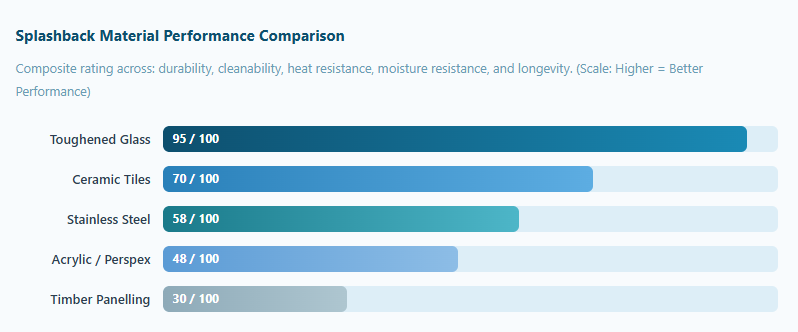
- Heat resistance: Acrylic is not heat resistant in the same way toughened glass is. It can warp, bubble, or discolour when exposed to sustained heat from a cooktop — making it unsuitable for direct installation behind most gas or electric cooktops without significant clearance. Toughened glass has no such limitation.
- Scratch resistance: Acrylic scratches relatively easily with regular cleaning and use. Glass is significantly harder and maintains its surface finish far better over time.
- Colour depth and clarity: Back-painted glass offers a richness and depth of colour that acrylic cannot replicate. The visual quality difference is noticeable — especially in direct comparison.
- Longevity: Toughened glass has a longer service life in kitchen environments than acrylic, which can yellow, scratch, or lose gloss finish over time under UV exposure and heavy use.
Acrylic splashbacks are typically lower cost at point of purchase, but the trade-off in performance and longevity means they’re generally not the recommended choice for kitchen splashbacks in Australian homes. For areas with minimal heat exposure (laundry feature walls, for example), they can be a budget-friendly option — but for any area near a cooktop, toughened glass is the appropriate choice.
Absolutely — and this is one of the most popular requests Shine Glass receives from Sydney homeowners and kitchen designers. Back-painted glass can be produced in virtually any colour, and suppliers with the right equipment and process can colour-match to most standard paint references (Dulux, Taubmans, Porter’s Paints, etc.) or to a specific sample you provide.
For something more visually distinctive, digitally printed glass opens up a much wider creative brief — from subtle linen or travertine textures through to bold botanical prints, geometric patterns, or high-resolution coastal photography. The print is applied to the back of the glass before toughening, protecting it from fading and abrasion indefinitely.
If you have a specific colour or design in mind for your Sydney kitchen, the best approach is to reach out to Shine Glass. Their team can advise on what’s achievable, provide physical samples where available, and give you accurate pricing based on your requirements.
