

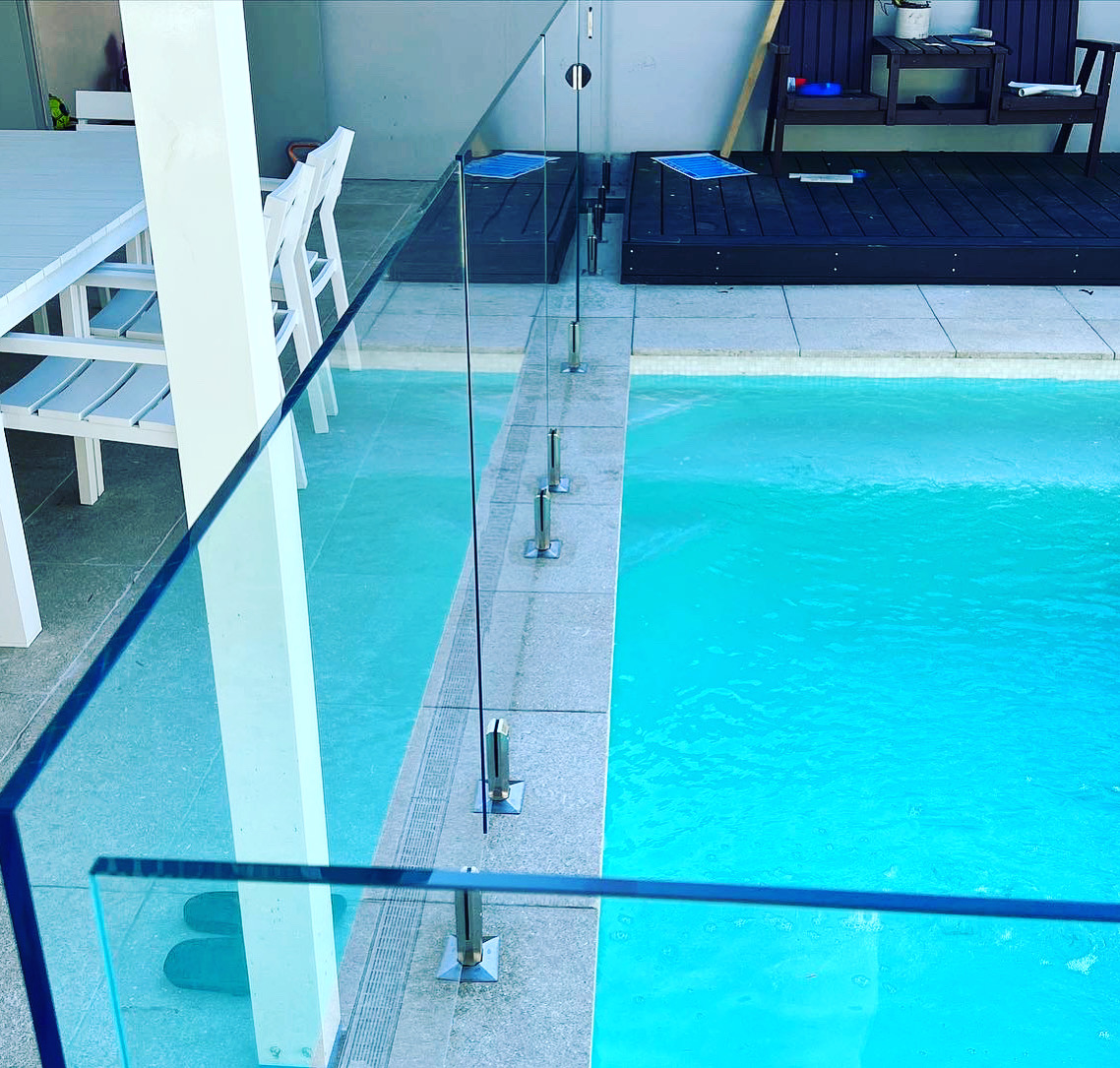
Glass pool fencing is now one of Sydney’s most popular pool barrier choices — and it is easy to understand why. Frameless glass panels deliver unobstructed views, satisfy strict NSW pool safety laws, and genuinely lift a property’s resale value. As of mid-2026, Sydney homeowners typically spend between $200 and $750 per linear metre on glass pool fencing, depending on whether the system is frameless or semi-frameless, the glass grade selected, and how complex the installation site proves to be.
Yet cost is only one part of the decision. Choosing the right glass thickness, understanding AS 1926.1-2012 compliance requirements, selecting a certified installer, and planning for Sydney’s coastal environment all shape the final result. This guide covers every element — clearly, honestly, and without filler.
| 12mm Minimum glass thickness for frameless pool fencing under AS 1288 | 1,200mm Minimum pool barrier height required under NSW regulations | $200-$750 Typical per-metre cost range for glass pool fencing in Sydney (2026) | 12mm Typical lifespan of quality toughened glass pool fencing with proper maintenance |
| Verified Fact – NSW Pool Safety Under the Swimming Pools Act 1992 (NSW), all residential pools must have a compliant child-resistant barrier. Pool owners must register their pool on the NSW Swimming Pool Register. Glass pool fencing, when installed to AS 1926.1-2012, fully satisfies this requirement. |
Why Sydney Homeowners Choose Glass Pool Fencing
Sydney’s outdoor lifestyle places pools at the heart of home design. Consequently, fencing must complement the space rather than interrupt it. A frameless glass pool fence achieves exactly that. Panels disappear visually, preserving sightlines from indoor living areas to the pool and garden beyond.
Moreover, quality glass is genuinely durable. Toughened safety glass resists corrosion, handles Sydney’s UV exposure without yellowing, and cleans easily compared to powder-coated metals. Unlike aluminium or timber, glass does not rust or warp over time. Therefore, the higher upfront investment often represents better long-term value.
Property valuers and real estate professionals consistently note that frameless glass pool fencing adds perceived value to Sydney homes. According to realestate.com.au buyer guides, outdoor entertaining spaces with premium finishes attract stronger offers in Sydney’s competitive market.
| “A well-installed frameless glass pool fence does not just meet compliance — it transforms the pool area into a design feature that buyers remember.” |
Additionally, glass balustrades and pool fencing from the same installation often create a cohesive outdoor aesthetic. Pairing pool fencing with matching staircase glass panels or deck balustrades delivers a unified, high-end appearance that individual fencing alone cannot match.
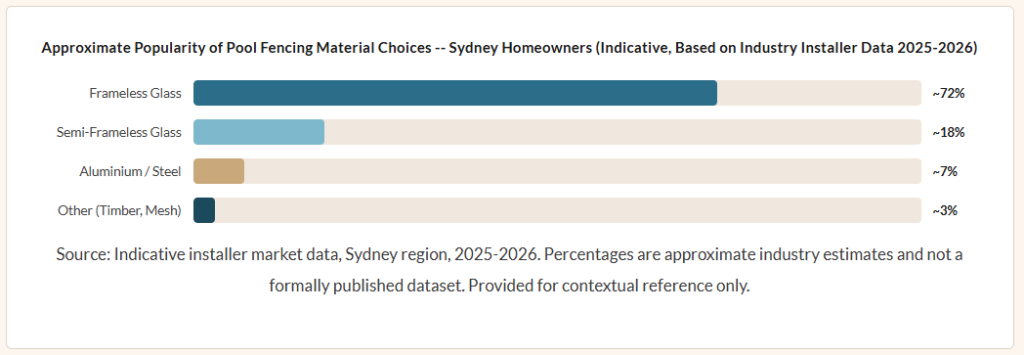
Frameless vs Semi-Frameless Glass Pool Fence Systems
Choosing between a fully frameless pool fence and a semi-frameless system depends on budget, aesthetics, and site conditions. Both meet NSW compliance requirements when installed correctly. However, each system has distinct advantages worth understanding before committing to a quote.
| Frameless Pool Fence • No visible posts or rails • Maximum transparency and view preservation • Requires 12mm toughened or laminated glass minimum • Uses stainless steel spigots anchored into ground or paving • Higher cost — approximately $350-$750 per linear metre in Sydney (2026) • Premium aesthetic, strong property value impact • Best for modern and contemporary Sydney homes |
| Semi-Frameless Pool Fence • Vertical posts at panel joints, no top or bottom rails • Good visual openness at lower price point • Typically uses 10mm or 12mm glass • Posts anchored into ground or fixed to paving surface • Moderate cost — approximately $200-$400 per linear metre in Sydney (2026) • Suits a broad range of home styles • Easier to accommodate uneven terrain |
Ultimately, frameless systems dominate Sydney’s premium residential market. Semi-frameless systems remain popular where budget is a primary concern or where site terrain makes spigot placement more challenging. Both require a self-closing, self-latching gate that opens away from the pool under NSW law.
| Verified Fact – Australian Standard AS 1926.1-2012 Standards Australia AS 1926.1-2012 governs swimming pool barriers in Australia. It specifies minimum fence height of 1,200mm, non-climbable zones, self-closing gate requirements, and glass panel specifications. Non-compliant pool barriers in NSW attract significant fines and create serious liability exposure. |
Understanding Glass Pool Fencing Cost in Sydney (2026)
Pricing for glass pool fencing in Sydney varies considerably. Several factors drive cost beyond simply the per-metre material rate. Understanding them helps homeowners evaluate quotes accurately and avoid unexpected expenses.
Key Cost Factors for Glass Pool Fencing
- System type: Frameless costs more than semi-frameless due to thicker glass and premium spigots.
- Linear metres required: Most residential Sydney pools require 12-25 linear metres of fencing.
- Glass grade: Toughened safety glass versus laminated glass affects both price and performance.
- Spigot and fitting quality: Marine-grade 316 stainless steel fittings cost more but resist Sydney’s coastal salt air far better.
- Site complexity: Sloped ground, paving removal, existing structures, or difficult access increase labour costs.
- Gate inclusion: Self-closing, self-latching gates add $400-$1,200+ depending on width and hardware.
- Compliance certification: Pool safety certificates from a licensed certifier add cost but are legally required for registration.
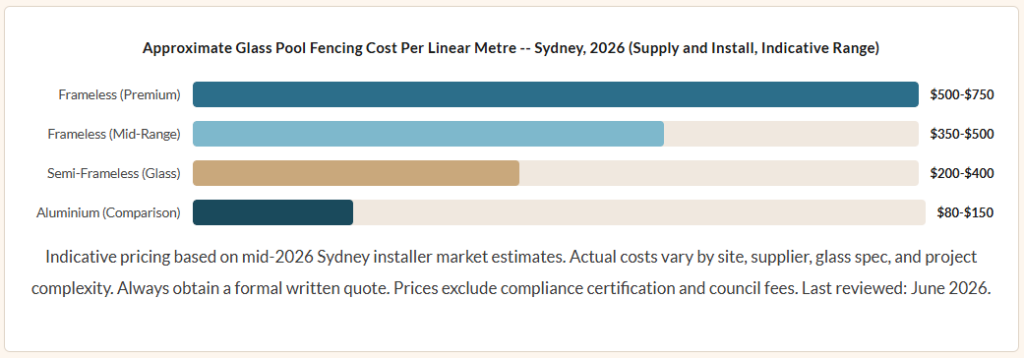
| Price Disclaimer All pricing figures above reflect indicative mid-2026 Sydney market estimates gathered from industry sources. They are not guaranteed quotes. Material costs, labour rates, and site-specific factors affect final pricing. Always obtain at least two written quotes from licensed glass contractors. Prices reviewed: June 2026. |
NSW Pool Fencing Regulations: What Sydney Homeowners Must Know
Pool safety law in NSW is comprehensive and strictly enforced. Specifically, the Swimming Pools Act 1992 (NSW) and its associated regulations set out barrier requirements for all residential pools. Furthermore, local councils conduct mandatory pool safety inspections at defined intervals.
Glass pool fencing, when installed to AS 1926.1-2012 and AS 1288, fully satisfies NSW barrier requirements. However, installation by an unlicensed contractor or to incorrect specifications can result in a failed inspection, fines, and costly rectification work.
Core NSW Pool Barrier Requirements
- Minimum barrier height of 1,200mm measured from finished ground level
- Non-climbable zone (NCZ) of 900mm must be maintained on the outside of the barrier
- No horizontal members or footholds within the NCZ that could assist climbing
- All gates must be self-closing and self-latching, opening away from the pool area
- Latch must be located at least 1,500mm above ground or be child-resistant
- Glass panels must meet AS 1288 thickness and toughening requirements
- Gaps between panels or under the fence must not exceed 100mm
- Pool must be registered on the NSW Swimming Pool Register
| Verified – NSW Swimming Pool Register All residential swimming pools and spas in NSW must be registered on the NSW Swimming Pool Register maintained by the NSW Government. Failure to register attracts penalties. A compliance certificate from a licensed pool safety inspector is required when selling or leasing a property with a pool. |
Glass Thickness and Safety Standards Explained
Many Sydney homeowners ask about glass thickness when comparing pool fencing quotes. The answer matters both for safety and legal compliance. Specifically, AS 1288 — Australia’s glass in buildings standard — governs minimum thickness requirements for pool fencing applications.
Minimum Glass Thickness Under AS 1288
- Frameless glass pool fencing: Minimum 12mm toughened safety glass. Some installations use 12mm laminated glass for additional impact resistance.
- Semi-frameless glass pool fencing: Minimum 10mm toughened safety glass, with 12mm preferred for panels over 1,200mm width.
- Toughened vs laminated: Toughened glass shatters into small granular pieces rather than sharp shards. Laminated glass holds together when broken, providing an additional safety layer around young children.
Additionally, all glass used in pool fencing must carry the Standards Mark indicating compliance with AS/NZS 2208 (Safety glazing materials in buildings). Reputable glass contractors will supply this documentation upon request. Therefore, always ask for product certification when receiving quotes.
For more information on how glass specifications apply across glass balustrades and related applications, Shine Glass provides expert guidance across all residential glazing projects.
The Glass Pool Fence Installation Process in Sydney
Understanding the installation process helps Sydney homeowners plan timelines and avoid disruption. A standard residential glass pool fencing installation by a qualified glass contractor typically follows these steps:
Site Assessment and Measure
A qualified installer visits the property to measure the perimeter, assess ground conditions, identify paving types, note slope or level changes, and plan spigot or post placement for compliance.
Quote and Product Selection
The installer provides a written quote specifying glass thickness, fitting grade (304 or 316 stainless), gate hardware, and total linear metres. Laminated versus toughened options are discussed at this stage.
Glass Fabrication and Order
Panels are custom-cut to site dimensions, toughened or laminated at the factory, and polished. Lead times in Sydney typically range from 5 to 15 business days depending on specification.
Spigot or Post Installation
Spigots are core-drilled into concrete or paving, or surface-mounted using base plates. Correct placement is critical for meeting NCZ and height compliance requirements under AS 1926.1-2012.
Panel and Gate Installation
Glass panels are installed into spigots or post channels, levelled, and secured. The self-closing, self-latching gate is fitted and adjusted. All gaps are checked against the 100mm maximum.
Compliance Check and Certification
A licensed pool safety inspector checks the installation against AS 1926.1-2012. A compliance certificate is issued upon passing. The certificate is required for NSW Swimming Pool Register obligations.
Durability, Maintenance and Sydney’s Coastal Environment
Sydney’s combination of salt air, high UV exposure, and variable humidity creates specific demands on pool fencing materials. Fortunately, properly specified glass and marine-grade fittings handle these conditions with minimal maintenance compared to other materials.
Maintaining Your Glass Pool Fence
Regular maintenance keeps glass pool fencing looking pristine and extends its operational life significantly. Luckily, the process is straightforward:
- Clean glass panels monthly with a mild glass cleaner or soapy water and a soft microfibre cloth
- Rinse thoroughly after cleaning to prevent soap residue buildup near the pool
- Inspect stainless steel spigots and fittings every six months for salt corrosion, particularly within 2km of the Sydney coastline
- Lubricate gate hinges and latch mechanisms every 3-6 months with a suitable marine lubricant
- Check gate self-closing and self-latching function monthly — this is a legal requirement under NSW pool safety law
- Remove calcium or mineral deposits using a non-abrasive calcium remover to protect glass clarity
Choosing the Right Stainless Steel Grade for Sydney
Not all stainless steel fittings perform equally in Sydney’s environment. Grade 304 stainless is adequate for inland Sydney areas. However, for properties within 5km of the coast or the harbour, marine-grade 316 stainless steel is strongly recommended. Grade 316 contains molybdenum, giving it significantly superior resistance to chloride corrosion from salt air and pool chemicals.
Quality glass contractors supply 316-grade fittings as standard for Sydney coastal projects. Always confirm fitting grade in your written quote. Furthermore, applying a stainless steel protective polish annually adds another layer of protection in high-salt zones.
| Verified – Stainless Steel Grades According to the Australian Stainless Steel Development Association (ASSDA), Grade 316 stainless steel is recommended for marine and coastal environments due to its molybdenum content, which provides superior resistance to pitting and crevice corrosion caused by chloride exposure. For Sydney pool fencing applications within coastal zones, 316-grade fittings are the appropriate specification. |
Glass Pool Fencing and Complementary Glazing Services
A well-designed Sydney outdoor area rarely stops at the pool fence. Many homeowners extend the glass aesthetic to adjacent areas, creating a cohesive, premium look throughout the property. Shine Glass provides the full range of complementary services to support this approach.
Glass Balustrades for Decks and Stairs
Decking adjacent to a pool benefits enormously from frameless glass balustrades that match the pool fencing system. Staircase glass panels continue the visual language from ground level to upper entertaining areas. Consequently, the entire outdoor space reads as a unified design rather than a series of disconnected elements.
Glass balustrading also increases safety on elevated decks while maintaining views — particularly valuable for Sydney properties with harbour, ocean, or garden outlooks that would otherwise be blocked by solid or semi-opaque barriers.
Shower Screens and Interior Glass
Inside the home, shower screens and glass splashbacks from the same supplier allow for consistent glass quality and finish. Shine Glass handles both interior and exterior glazing, simplifying the process for Sydney homeowners undertaking broader renovation projects.
Selecting a Qualified Glass Pool Fence Installer in Sydney
Choosing the right pool fence installer is as important as choosing the right glass. In NSW, glass contractors must hold a current NSW Fair Trading contractor licence. Additionally, experienced installers carry current public liability insurance and provide written warranties on both supply and workmanship.
Questions to Ask Before Hiring a Glass Pool Fence Contractor
- Do you hold a current NSW contractor licence? (Request the licence number and verify it)
- Do you carry public liability insurance? (Request a current certificate of currency)
- What glass thickness and grade will you supply, and can you provide product certification?
- Are your spigots and fittings 316-grade marine stainless for coastal Sydney sites?
- Will the installation comply with AS 1926.1-2012 and AS 1288?
- Do you arrange or coordinate the pool safety compliance certificate?
- What warranty applies to the glass and the workmanship separately?
- Can you provide references or photos of recent glass pool fence installations in Sydney?
Reputable contractors answer all of these questions confidently and in writing. Be cautious of any installer who is vague about licensing, insurance, or glass specifications. Furthermore, the cheapest quote rarely represents the best value when compliance failures and rectification work are factored in.
Glass Pool Fencing Design Trends in Sydney for 2026
Sydney’s architectural trends continue to favour clean lines, natural materials, and maximised indoor-outdoor connection. Glass pool fencing aligns naturally with all three directions. In 2026, several specific trends are shaping how Sydney homeowners approach pool fencing design.
Low-Profile Spigot Systems
Flush-mount and ultra-low-profile spigot designs have gained popularity across Sydney’s prestige residential market. These systems position the spigot almost entirely below the paving line, creating an almost invisible connection between glass panel and ground. The result is a seamless transition from poolside surface to glass barrier.
Tinted and Low-Iron Glass Panels
Standard float glass has a faint green tinge from iron content. Low-iron (super-clear) glass eliminates this, producing water-white clarity that enhances the pool’s visual appeal significantly. Meanwhile, light grey or bronze tint options remain popular for properties where some privacy or heat reduction is desired without sacrificing the open feel.
Integrated Pool Fencing and Landscaping
Sydney landscape designers increasingly plan pool fencing and garden elements together from the outset. Frameless glass integrates naturally with sandstone, timber decking, and native plantings that define contemporary Sydney outdoor spaces. Additionally, combining glass pool fencing with matching frameless glass balustrades across decks, stairs, and viewing platforms creates a layered, high-end result.
Frequently Asked Questions About Glass Pool Fencing
In Sydney as of 2026, glass pool fencing typically costs between $200 and $750 per linear metre for supply and installation. Frameless systems sit at the higher end ($350-$750/m). Semi-frameless systems range from $200 to $400/m. Gate hardware, site complexity, and compliance certification add to total project cost. Always request a formal written quote. Prices were last reviewed June 2026.
Yes. Glass pool fencing manufactured to AS 1288 and installed under AS 1926.1-2012 meets Australian pool barrier safety standards. Toughened safety glass is engineered to withstand significant impact. When it does break, it shatters into small granular pieces rather than dangerous shards. Laminated glass goes further by holding the panel together on breakage.
Under AS 1288, frameless glass pool fencing panels require a minimum thickness of 12mm toughened or laminated safety glass. Semi-frameless systems typically use 10mm or 12mm toughened glass. Thicker glass is sometimes specified for wider panels or high wind-load sites. Your installer should confirm the correct specification in writing.
Yes. Aluminium pool fencing generally costs $80-$150 per linear metre in Sydney, making it considerably cheaper than glass. However, glass adds significant property value, visual appeal, and unobstructed sightlines that aluminium cannot replicate. For homeowners prioritising aesthetics and resale value, glass is the preferred long-term investment.
DIY glass pool fence installation is not recommended in NSW. Pool barriers must meet strict compliance standards under AS 1926.1-2012. Incorrect installation can result in a failed pool safety inspection, fines, and serious safety and liability consequences. Furthermore, most glass suppliers will not supply frameless pool fence glass to non-licensed installers. Always use a licensed glass contractor.
Clearview-style frameless glass fencing in Sydney ranges from approximately $350 to $750 per linear metre for supply and installation as of 2026. Final pricing depends on glass grade, spigot specification, gate requirements, and site conditions. Pricing reviewed June 2026. Always obtain a formal written quote for accurate project costs.
Glass itself is non-conductive and does not require earthing. However, metal spigots, posts, or structural fittings used with glass pool fencing may require earthing under AS/NZS 3000 electrical wiring rules, particularly when near pool pumps or electrical equipment. Consult a licensed electrician regarding any metalwork within the pool zone.
Aluminium or tubular steel pool fencing is generally the cheapest compliant option in Sydney, starting around $80 per linear metre. Among glass options, semi-frameless glass is the most affordable, sitting below fully frameless systems. All compliant fencing types must meet AS 1926.1-2012 regardless of price point.
High-quality toughened glass pool fencing can last 20 to 30 years or more with appropriate maintenance. The glass panels themselves rarely fail. Marine-grade 316 stainless steel fittings extend the system’s longevity considerably, particularly in Sydney’s coastal and humid environments. Regular inspection and cleaning significantly extend service life.
Yes. Under AS 1926.1-2012 and the Swimming Pools Act 1992 (NSW), all pool barrier gates must be self-closing and self-latching, opening away from the pool. The latch must be positioned at least 1,500mm from the ground or be designed so children cannot reach or operate it. This applies equally to glass pool fence gates.
Yes. Experienced glass pool fence installers can accommodate sloped or uneven ground through stepped panel installation or raking techniques. Semi-frameless systems often handle slope more flexibly than fully frameless spigot systems. Site assessment by a qualified installer is essential before quoting on sloped properties.
Toughened (tempered) glass is heat-treated to increase strength and shatter into small granular pieces on breakage. Laminated glass consists of two glass layers bonded with an interlayer, so it holds together when broken rather than falling apart. Both meet AS 1288 requirements for pool fencing. Laminated glass offers an additional safety margin, particularly valued in family environments with young children. See Wikipedia: Safety Glass for a general technical overview.
Conclusion: Making the Right Glass Pool Fencing Decision for Your Sydney Home
Glass pool fencing delivers a combination of safety, compliance, aesthetics, and durability that no other pool barrier material matches in Sydney’s market. Choosing the right system — frameless or semi-frameless, 12mm toughened or laminated, 304 or 316 stainless fittings — depends on your site, budget, and how the pool integrates with the rest of your outdoor space.
Compliance with AS 1926.1-2012 and NSW pool safety regulations is non-negotiable. Therefore, selecting a licensed, experienced glass contractor who provides written product certification and arranges compliance inspection is the single most important decision in the project.
Shine Glass has served Sydney homeowners across pool fencing, glass balustrades, shower screens, and splashbacks with exactly this level of expertise and accountability. Whether you are replacing an existing fence, installing a new pool barrier, or extending glass finishes throughout your property, the team at Shine Glass brings the experience Sydney homes deserve.
