

Commercial glazing plays an important role in the safety, functionality, and appearance of commercial buildings. Property managers, builders, strata managers and business owners may need commercial glazing for new installations, renovations, damaged glass replacement or upgrades to existing spaces.
However, getting the right result involves more than choosing a glass panel that fits an opening. Incorrect measurements, unsuitable glass specifications, incompatible frames or hardware, poor sealing, and inadequate installation planning can lead to delays, additional costs, operational disruptions, and problems with the finished installation. A professional glazing team can assess site conditions, clarify the required specifications, coordinate installation requirements, and identify potential issues before work begins.
In this guide, we are going to explain what a commercial glazing quote should include, how to compare contractors fairly, which exclusions and warning signs to look for, and what information to prepare before requesting a quotation. Whether you are comparing proposals for a shopfront, office fit-out or another commercial glazing project, these practical steps will help you make a more informed decision.
What does commercial glazing include?
Commercial glazing can cover replacement panes, shopfronts, office doors, glazed partitions, entry systems and architectural glass. Some jobs involve one damaged panel; others include multiple openings, new frames, hardware and staged installation around trading hours.
A wider scope may include glass balustrading, glass balustrades, a frameless glass balustrade, glass balcony railings or staircase glass panels. Also, refurbishments may involve glass splashbacks and mirrors, glass shower screens, a glass pool fence or a frameless pool fence.
What should a commercial glazing quote include?
A useful quote describes the work clearly enough for the buyer to understand what will be supplied, how it will be installed, what will be handed over, and what remains outside the price.
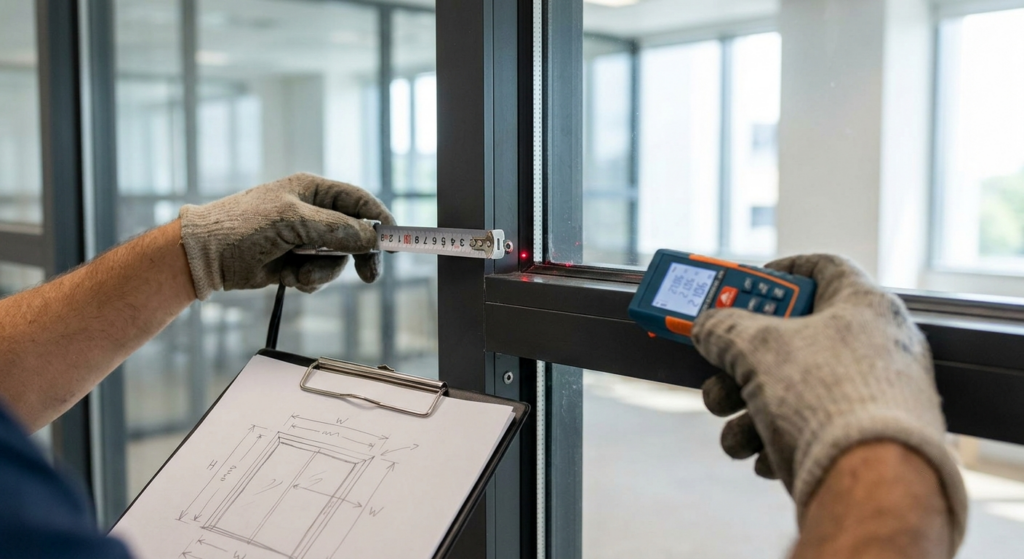
You may also use this itemised checklist when assessing each proposal:
• Project and opening schedule: Confirm the site, work area, panel references, quantity, and whether the job is new, replacement, or repair. The quote should match your drawings or marked-up photos.
• Glass specification: Request glass type, thickness, applicable safety classification, finish, tint or coating, and any acoustic, privacy, thermal, or security performance. If undecided, ask what assumptions underpin the price.
• Frames and supporting system: Confirm whether existing frames stay or are replaced. Identify the relevant frame system, material, profile, colour, finish, seals and fixing approach; avoid vague wording such as “standard framing”.
• Doors and hardware: List handles, locks, hinges, closers, floor springs, tracks and access-control interfaces. Mark each item as included, supplied by another trade, or excluded.
• Measurement and preparation: State whether site inspection or a final check measure is included. Note assumptions about the opening, substrate, services and readiness for installation.
• Removal and disposal: Confirm who removes old glass, frames, sealants and hardware and who disposes of them. “Replacement” does not necessarily mean removal is included.
• Installation labour and access: Check delivery, handling, lifting equipment, scaffolding or elevated platforms, protection, pedestrian management and restricted-hours work where relevant.
• Sealing and making good: Clarify responsibility for perimeter sealing, trims, patching, painting, cladding repairs and reinstatement. Another trade may need to do some of this work.
• Programme and coordination: Ask for lead time, installation duration, work hours and dependencies. If the premises stays open, specify access windows and work-area arrangements.
• Compliance and handover: Ask which standards, product details or installation records apply, and what will be supplied at completion. Requirements vary by building and system.
• Price and terms: Check costs, GST, delivery or access charges, payment terms, expiry, warranties and the variation-approval process.
• Exclusions and assumptions: Identify excluded work, provisional sums, owner-supplied materials and conditions that could change the price. Resolve unclear points in writing.
How to compare commercial glazing quotes fairly
Give glass contractors the same brief, drawings, photos, access information, and deadline, and then compare responses under the same headings. Remember, a supply-and-install quote cannot be compared directly with a supply-only price.
1. Align the scope before looking at the price
Put each opening or work area on a shared list. Compare quantities, glass specification, frame and hardware, removal, installation, access, finishing, and handover. Where a quote says “by others”, identify the person or trade responsible and obtain a separate price if needed.
2. Separate confirmed inclusions from assumptions
Mark each line as included, excluded, not specified, or subject to inspection. Since “Not specified” does not mean included, ask for written clarification on anything affecting safety, appearance, operation, or budget.
3. Check delivery and disruption
A quote that fits the budget but misses the access window may not fit the project. Confirm lead time, installation duration, staging, noise restrictions, and any need to close trading or shared areas.
4. Review the contractor and the handover
Ask who supervises the work, how variations are approved, and what support is available for post-installation adjustments. Also, request relevant examples and check references where appropriate.
5. Compare the adjusted total
Add separately quoted costs for missing items and resolve risks. Do not use arbitrary allowances to force quotes to match; ask the contractor to price the gap. The best proposal should fit the brief, programme and required outcome.
Use a simple comparison sheet
Create one row per requirement and columns for Quote A, Quote B, the difference, and the action needed. Mark each item as matched, clarification needed, or excluded/extra. Keep the original and adjusted totals visible so a scope adjustment is not mistaken for the contractor’s submitted price. For unresolved items, record who will confirm the answer and ask for a revised quote in writing.
Worked example: why the lower quote may cost more

The figures below are hypothetical and are used only to show a comparison method. It is not a guide to what a glazing job should cost.
| Item | Quote A | Quote B |
| Base supply and installation | $18,600 | $16,900 |
| Removal and disposal | Included | Not specified |
| Elevated access equipment | Included | Excluded |
| Perimeter sealing and making good | Included as described | Excluded |
| After-hours installation | Included for the agreed window | Not allowed for |
Quote B is initially $1,700 cheaper, but omits several items included in Quote A. Request a revised scope before choosing. For illustration only, adding $1,100 for access, $650 for removal and disposal, $500 for sealing and making good, and $450 for after-hours work would bring Quote B to $19,600, more than Quote A.
This does not prove one contractor is better. It shows why scope must be aligned first. Actual additional charges must come from the contractor and site conditions, not unrelated price guides.
Red flags and exclusions to resolve before signing
- One unexplained total: Ask for enough detail to identify the glass, frames, hardware, and work being purchased.
- Vague glass wording: Terms such as “safety glass” or “commercial grade” may be insufficient on their own. Request the actual specification and confirmation that it suits the application.
- No clear installation scope: Check whether removal, access, labour, sealing, protection, clean-up and disposal are included.
- Unpriced assumptions: Frame damage, unsuitable substrates, concealed services, out-of-hours access and additional building work should be addressed as inclusions, exclusions or variation triggers.
- Unclear timing or payment terms: Get the lead time, expected site duration, payment schedule, quote expiry and variation-approval process in writing.
- Unclear responsibility for approvals: Confirm who coordinates with the owner, strata, centre management, builder, certifier or other relevant project parties. Do not assume the glazier is managing approvals unless the quote says so.
For compliance, ask which current requirements apply to your building and glazing system rather than relying on a generic “to code” promise. Also, for general guidance, you may consult the NSW Government guide to complying with the National Construction Code, and then confirm project-specific interpretation with the relevant design or certification professional.
What information should you send before requesting a quote?
Commercial window installers and other glass contractors can scope a job more efficiently when you provide:
• Site address, building type, and the best site contact.
• A short description of the work: new fit-out, replacement, upgrade, or repair.
• Architectural drawings, elevations, a glazing schedule, or marked-up photos, if available.
• Approximate opening dimensions and the number of panels or doors, clearly labelled as preliminary if not professionally measured.
• Preferred glass performance, frame finish, hardware, privacy needs and any design specification already selected.
• Access limits, loading arrangements, working hours, occupancy constraints and any centre-management or strata conditions.
• Target installation date, staging requirements and the process for site access.
• Known exclusions, budget parameters where appropriate and any required handover information.
Rough dimensions are not a final manufacturing measure and a site visit may be needed to confirm openings, frames and installation constraints before pricing is firm.

Copyable commercial glazing brief
Use this short template when inviting quotations. Send the same version to each contractor and share any revisions with everyone who is pricing the project.
- Project and address: [Name, full site address and building contact]
- Scope: [New installation, replacement, repair or fit-out; areas and opening references]
- Drawings and photos: [File names, revision dates and marked-up locations]
- Glass and frame requirements: [Specification provided by the design team or items requiring contractor advice]
- Doors and hardware: [Required fittings, access control and finish details]
- Site conditions: [Floor level, access, loading, occupied areas, protection and work-hour limits]
- Include in the price: [Measure, supply, delivery, removal, disposal, installation, sealing, clean-up and handover—confirm each item]
- Programme: [Required date, allowed working hours and staging]
- Quote response: [Itemised scope, exclusions, assumptions, GST, payment terms, validity, warranties, lead time and variation process]
- Contact and response date: [Name, email, phone and closing date for submissions]
Ask contractors to flag unpriced details, explain any required inspection or design input, and list provisional sums separately. This will help you separate genuine price differences from different assumptions.
Frequently asked questions
It should identify the work, glass and frame specifications, hardware, quantities, installation method, access requirements, removal and disposal, finishing, timing, price, GST treatment, payment terms, warranties, exclusions and variation process. Also, ask what project-specific compliance or handover documents will be provided.
Quotes may specify different glass, frames or hardware, or allow for different removal, access, labour, finishing and work hours. Compare the scope line by line before judging the price difference.
No. Confirm the specification, installation and finishing are covered, then weigh programme, relevant experience, written terms and handover against the adjusted total.
Drawings, photos and approximate dimensions may support an initial estimate. A site inspection or final check measure may be needed before confirming price or manufacturing; ask what each quote is based on.
They must be clear but are not automatically included. Confirm who removes and disposes of old materials, protects the area and completes sealing or making-good work.
Where practical, obtain comparable written proposals from more than one suitable contractor. Give each the same brief and allow time for clarification before comparing totals.
Ask which current requirements apply, who confirms the specification, and what product or installation records will be supplied. Requirements largely depend on the building and application, so seek project-specific advice.
Request a commercial glazing quote with a clear scope
A clear brief helps contractors price the same work and gives you a better basis for selection. So, before committing, confirm the written scope, exclusions, timing, and handover. Also, send drawings, site details, and marked-up photos for projects involving glass doors and windows, entries, partitions, or balustrades.
For a project-specific discussion, contact Shine Glass about your glazing requirements and confirm the required scope as well as the service location before requesting a formal quotation.
