

Choosing the right window and door installers in Australia is not simply a matter of price. Licensing, NCC compliance, product warranties, and local climate suitability all shape how your installation holds up over the next 20 to 30 years.
Most Australian homeowners start researching window and door installers only after they notice a draught, a rattling frame, or a sky-high energy bill. By then, decisions get rushed. Consequently, poorly chosen installers leave behind leaking frames, voided product warranties, and non-compliant glazing that fails building inspections. This guide exists to prevent exactly that.
Throughout this article, you will learn how to verify licensing, understand double glazed window installation costs in Australia, read NCC compliance requirements for 2026-2027, navigate aluminium frame selection for coastal properties, and avoid the warranty traps that catch thousands of NSW homeowners each year.
Why the Right Installer Changes Everything for Your Property
Window and door installation sits at the intersection of structural integrity, thermal performance, and legal compliance. Furthermore, a poorly installed frame can void the manufacturer’s product warranty before the first year ends. Beyond that, water ingress caused by failed seals creates mould, structural rot, and costly remediation work that dwarfs the original installation fee.
Australian homeowners frequently underestimate how much installer quality affects long-term outcomes. For instance, two homes may receive identical window products, yet one performs beautifully for 25 years while the other deteriorates in under five. The difference, in almost every case, comes down to the trade qualifications of the person who fitted them.
Additionally, building surveyors across NSW have flagged non-compliant window installations as one of the most common defects found during property transfers. Addressing them post-settlement becomes the buyer’s financial burden. Therefore, ensuring your installer meets current standards protects your investment at every stage.
Licensing and Qualifications to Look For in Australia
In Australia, the licensing requirements for window and door installers vary by state. However, in NSW, most residential window and door installation work requires a contractor’s licence issued by NSW Fair Trading, particularly when structural elements are involved. Simply put, always ask to see the licence before work begins.
Beyond the contractor’s licence, look for current insurance coverage. Specifically, public liability insurance and HBCF (Home Building Compensation Fund) (where applicable) protect both the homeowner and the installer. Without these, any damage during installation becomes a personal cost dispute with no regulatory safety net.
Trade Qualifications That Signal Competence
A qualified glazier in Australia typically holds a Certificate III in Glass and Glazing, which covers safe glass handling, frame installation, and weatherproofing. Additionally, partnering with an Australian Glass and Window Association (AGWA) accredited installer indicates a firm commitment to current national building codes and independent performance audits.
Moreover, some window and door installers carry endorsements from specific manufacturers. These endorsements often unlock extended product warranties and confirm that the installer has completed the manufacturer’s own installation training. Always ask about this, because it directly affects your warranty entitlements.
✓ Licensing Checklist – Ask Before You Book
- Current NSW Fair Trading Contractor Licence (or equivalent for your state)
- Public liability insurance – minimum $5 million recommended
- Certificate III in Glass and Glazing (for glazier specialists)
- HBCF (Home Building Compensation Fund) for projects over $20,000 in NSW
- AGWA membership or relevant industry body affiliation
- Manufacturer endorsement or authorised installer status
- References from recent NSW or local area installations
Verified Fact
NSW Fair Trading requires contractors performing structural or integrated installation work to hold a current licence. Unlicensed work on residential buildings can result in fines and renders associated warranties void.
Source: NSW Fair Trading – fairtrading.nsw.gov.au | Verified June 2026
Understanding Window and Door Installation Costs Across Australia
Cost transparency is one of the biggest gaps in the Australian window installation market. Many homeowners receive vague verbal quotes, then face significant variations at invoice time. Understanding the cost components upfront helps you compare window and door installation quotes in Australia with genuine confidence.
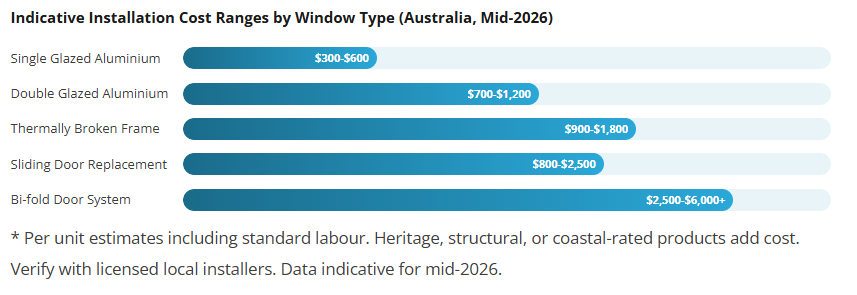
Generally, standard window replacement in mid-2026 Australia involves both material and labour components. Material costs vary enormously depending on frame type, glazing specification, and window size. Labour costs depend on access conditions, installation complexity, and whether structural changes are required.
Pricing Disclaimer: All price ranges below are indicative estimates based on publicly available Australian market data and industry references current as of mid-2026. Prices vary significantly by region, supplier, product specification, and site conditions. Always obtain written itemised quotes from at least three licensed installers before committing to any work. Do not use these figures as a fixed budget guide.
| $150-$400 Average labour per window (standard replacement, mid-2026) | 3+ Quotes recommended before committing to any installer | $20,000 NSW threshold above which HBCF (Home Building Compensation Fund) is mandatory |
Sliding Door Replacement Near You – What Affects Pricing
Sliding door replacement near you involves more variables than standard window replacement. Track condition, structural lintel integrity, and weatherproofing requirements all influence the final cost. Additionally, if the existing opening requires modification to accept a new door size, labour costs rise accordingly.
For coastal NSW homes, marine-grade aluminium track systems and hardware add to material costs. However, this investment is worthwhile given the accelerated corrosion that standard components experience near salt air environments. Cutting corners on hardware for coastal sliding doors leads to premature failure and repeat replacement costs.
Double Glazing and Energy Efficiency for Australian Homes in 2026
Double glazed window installation cost in Australia has become a frequent search topic as energy bills rise and climate comfort expectations increase. Fortunately, prices have become more competitive as local manufacturing capacity has grown. Moreover, government energy efficiency programs have encouraged broader adoption across NSW and beyond.
Double glazing works by trapping an insulating air or gas layer between two panes of glass. This significantly reduces heat transfer, cutting both heating and cooling loads. Consequently, homes with double glazed windows typically experience year-round comfort improvements alongside measurable energy bill reductions.
Single Glazing vs. Double Glazing – Key Differences
Single Glazing
Higher heat transfer in summer and winter
Lower upfront material cost
Condensation forms more easily on inner pane
Less effective acoustic insulation
Does not meet NCC energy
efficiency requirements in many climate zones
Double Glazing
Significantly reduced heat loss and gain
Higher upfront cost with long-term energy savings
Minimises condensation on inner surface
Improved acoustic performance
Meets or exceeds 2026-2027 NCC energy efficiency requirements
Thermally Broken Frame
Premium thermal barrier in aluminium frame
Eliminates cold bridging through the frame
Ideal for cooler Australian climate zones
Often paired with double or triple glazing
Higher investment, maximum long-term performance
Verified Fact
According to the Australian Government’s YourHome guide, windows and glazing are responsible for up to 40% of a home’s heating energy loss and up to 87% of its heat gain in summer.
Source: YourHome – Australian Government – yourhome.gov.au | Verified June 2026
Furthermore, low-emissivity (low-E) glass coatings work alongside double glazing to reflect radiant heat while allowing visible light through. In hotter Australian climates, selecting a low-E specification with a low Solar Heat Gain Coefficient (SHGC) is critical to block solar radiation. Work with your installer to match the U-value and SHGC metrics to your specific NCC climate zone.
Aluminium Window Frame Installation and Coastal Corrosion Resistance
This remains the dominant choice for Australian residential projects. Aluminium offers strength, low maintenance, slim sightlines, and excellent longevity when correctly specified. However, not all aluminium is equal – especially for coastal NSW properties exposed to salt-laden air.
Standard aluminium frames use anodised or powder-coated finishes. Both provide good corrosion resistance for inland and suburban locations. However, coastal aluminium window corrosion resistance requires a higher specification. Marine-grade finishes and specialized 25-micron anodising thicknesses are essential for properties located within 5 kilometres of coastal waters to comply with AS 2047 corrosion requirements.
What to Specify for Coastal Window Installations
For properties in coastal NSW suburbs including the southern Sydney region, Cronulla, and surrounding areas, specify aluminium windows with a minimum anodising coating of 25 microns or a high-quality polyester powder coat with marine-grade primer. Additionally, stainless steel or marine-grade fasteners should replace standard steel screws throughout the installation.
Moreover, seals and weather strips should use EPDM rubber compounds rated for UV and ozone exposure. Standard rubber seals degrade rapidly in coastal salt-air environments, leading to water ingress and frame rattling within a few years of installation.
NCC Compliance for Windows and Doors – What Australian Homeowners Must Know
The National Construction Code (NCC) sets mandatory performance standards for all new window and door installations in Australian residential buildings. Adhering to energy-efficient glazing metrics under the NCC framework is not optional; it directly dictates your property’s structural building approval and eventual occupancy certification.
Specifically, NCC 2022 (Volume Two, applicable to Class 1 residential buildings) introduced strengthened energy efficiency provisions. These require all new residential windows to meet minimum thermal performance standards based on climate zone. As a result, windows specified for a Sydney coastal home must comply with Climate Zone 5 requirements under the NCC.
Climate Zones and Their Impact on Window Specification
Australia is divided into eight climate zones under the NCC. Each zone carries different requirements for glazing U-values and Solar Heat Gain Coefficients (SHGC). Therefore, an installer who recommends the same product for every project regardless of location is cutting corners on compliance.
Additionally, the NCC 2022 pathway options allow compliance through either the Deemed-to-Satisfy (DtS) provisions or a NatHERS energy rating assessment. A knowledgeable installer should discuss both pathways and advise on which is most cost-effective for your specific project scope.
Non-Compliance Warning
Installing windows that do not meet NCC energy efficiency requirements can result in failed building inspections, delays to occupancy certificates, and personal liability if the property is later sold. Always confirm NCC climate zone compliance with your licensed installer before ordering products.
Verified Fact
The Australian Building Codes Board (ABCB) administers the NCC and provides free access to the full code online. NCC 2022 energy efficiency provisions for housing are detailed in Section J and the relevant climate zone maps.
Source: ABCB – abcb.gov.au | Verified June 2026
Window Installation Warranties in Australia – What to Look For
Window installation warranty coverage in Australia involves two distinct components: the product warranty from the manufacturer and the workmanship warranty from the installer. Both matter, and both should be confirmed in writing before any contract is signed.
Product warranties from reputable Australian window manufacturers typically range from 7 to 15 years on frames and 5 to 10 years on sealed double glazed units. However, most product warranties are conditional on installation by a licensed and, in many cases, manufacturer-authorised installer. Therefore, choosing an unlicensed installer to save a few hundred dollars often voids thousands of dollars in product warranty protection.
Workmanship Warranty – What Is Reasonable
A professional window and door installer should offer a minimum 2-year workmanship warranty on installation quality. This covers labour defects such as failed seals, misaligned frames, and inadequate weatherproofing. Some installers offer longer terms – 5 years or more – which reflects genuine confidence in their work quality.
Furthermore, any window installation project exceeding $20,000 in NSW automatically requires statutory HBCF (Home Building Compensation Fund) under the Home Building Act 1989. This provides homeowners with a safety net if the contractor dies, disappears, or becomes insolvent before defects are rectified. Verify that this cover is in place before any large-scale project begins.
Replacing Old Windows vs. Completely New Installation – Making the Right Call
One of the most common questions homeowners ask window and door installers is whether to replace existing frames or install entirely new systems. The answer depends on the age, condition, and material of existing frames alongside the scope of any renovation work underway.
Generally, replacement (or retrofit) installation suits situations where the existing opening size remains unchanged and the surrounding wall structure is sound. Consequently, costs are lower because structural work is minimal. However, if frames are heavily corroded, warped beyond adjustment, or non-compliant with current NCC requirements, full removal and new installation is the smarter long-term decision.
Additionally, homes undergoing extensions or renovations often benefit from integrating new window and door specifications into the broader building contract. Doing so ensures climate zone compliance, consistent aesthetics, and coordinated warranty coverage across the whole project.
Heritage Window Replacement Regulations Across Australia
Heritage window replacement regulations in Australia add a layer of complexity that many homeowners and even some installers underestimate. Properties listed on a heritage register – whether local, state, or national – carry specific obligations around window replacement that standard installations do not.
In NSW, the Heritage Office guidelines generally require that window replacements on heritage-listed properties match the original profile, material, and visual appearance of the existing windows. Substituting timber frames with aluminium, for instance, may be refused entirely unless the change is reversible and historically appropriate.
Therefore, if your property carries any heritage listing or sits within a heritage conservation area, contact your local council before engaging any window and door installers. A heritage advisor or architect may be required to assess proposed changes. Furthermore, some councils offer heritage grants that partially fund sympathetic window replacement work.
How to Get Reliable Window and Door Installation Quotes in Australia
Getting accurate window and door installation quotes in Australia requires more than simply asking “how much?” A meaningful quote must be itemised, include both supply and installation costs, specify the exact products being installed, and reference any applicable standards or compliance requirements.
Obtain at least three written quotes before committing. Compare them line by line – not just the total. Specifically, check whether each quote includes removal and disposal of existing frames, weatherproofing and sealing, NCC-compliant glazing specification, and post-installation cleanup.
Red Flags in Window Installation Quotes
- Verbal quotes with nothing in writing
- Requests for large cash deposits upfront (over 10% before work starts)
- No mention of licensing or insurance details
- Products not meeting Australian Standard AS 2047
- No warranty terms clearly stated in writing
- Pressure to sign immediately without time to review
- Unusually low pricing with no clear explanation of what is excluded
Additionally, always ask for a site visit before a quote is finalised. An honest installer will identify any structural concerns, measure openings accurately, and advise on glazing specifications suited to your specific home and location. Quotes provided without a site visit are rarely reliable.
✓ What a Good Installation Quote Must Include
- Installer’s full business name, licence number, and ABN
- Itemised supply and labour costs
- Exact product specifications including glazing type and frame material
- AS 2047 and NCC compliance confirmation
- Workmanship warranty period and terms
- Timeframe for completion
- Payment schedule (avoid large upfront deposits)
- Removal and disposal of existing frames included or excluded
Complementary Glass Services That Work Alongside Window and Door Installation
Window and door work rarely happens in isolation. Most NSW homeowners undertaking a renovation or upgrade also explore complementary glass solutions that improve the home’s safety, aesthetics, and value. Shine Glass provides several services that integrate naturally with window and door upgrades.
For instance, if your renovation includes an outdoor entertaining area, glass pool fencing provides a compliant, low-maintenance safety barrier that preserves sightlines to the pool. Frameless and semi-frameless options suit modern designs beautifully.
Similarly, bathroom renovations that update windows often benefit from concurrent shower screen replacement. A consistent glass specification across shower screens, mirrors, and windows creates visual cohesion throughout the home.
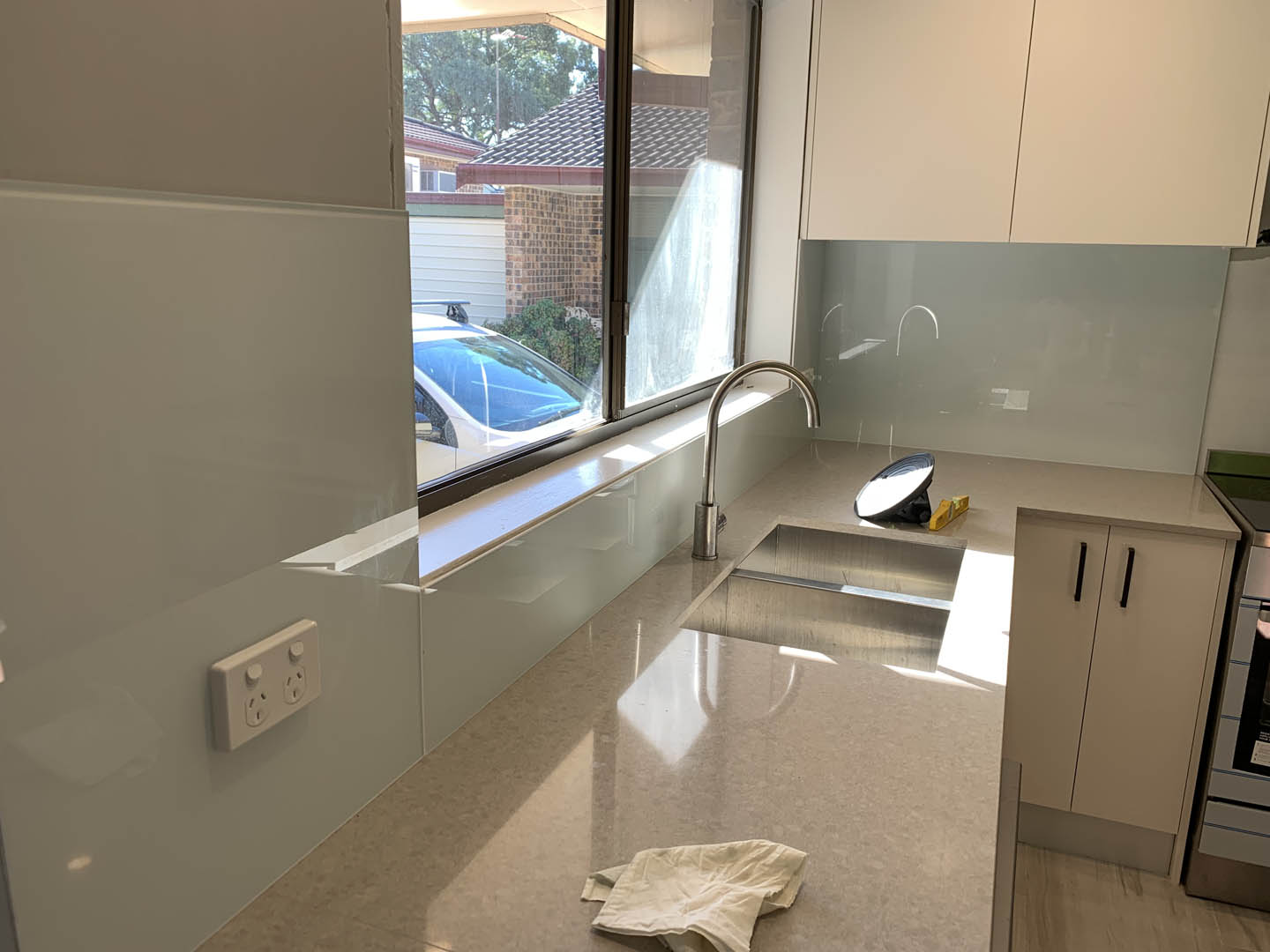
Furthermore, glass balustrades for decks, staircases, and balconies pair naturally with new sliding door and bifold door installations, maintaining uninterrupted views while meeting safety code requirements. For kitchens, glass splashbacks complement new window installations, reflecting light and adding a premium finish that completes a full kitchen renovation.
Each of these services benefits from the same principle: professional installation by qualified specialists using compliant materials. Therefore, bundling related glass work with your window and door project can reduce mobilisation costs and ensure consistent quality across your entire renovation.
Frequently Asked Questions About Window and Door Installers in Australia
How much does it cost to install windows and doors in Australia?
Window installation in Australia generally ranges from $300 to $1,200 per window for standard sizes as of mid-2026, depending on frame material, glazing type, and labour complexity. Door installation typically adds $400 to $2,500 per door. Always request itemised written quotes from at least three licensed installers, as pricing varies significantly by region, product specification, and site conditions. These figures are indicative and should not be used as a fixed budget.
What is the average labour cost to install a window in Australia?
Labour costs for window installation in Australia typically sit between $150 and $400 per window for standard residential replacements as of mid-2026. Access difficulties, structural modifications, and heritage requirements increase labour costs. Always confirm labour costs separately from supply costs in your written quote.
How much does it cost to install a door where a window is?
Converting a window opening to a door typically costs between $1,500 and $4,500 in Australia, depending on structural modifications required. If the lintel needs replacement, wall modifications are needed, or the opening size changes significantly, costs rise accordingly. Always engage a licensed builder or structural engineer to assess the opening before work begins.
What do you call someone who fits windows and doors?
In Australia, professionals who fit windows and doors are commonly called glaziers, window installers, or joinery installers. Some are also licensed builders who specialise in window and door installation. You can learn more about the glazier trade on Wikipedia. Always verify current Australian trade qualifications and licensing before engaging anyone.
Is it worth replacing 20 year old windows?
Yes, in most cases. Windows aged 20 or more years often have degraded seals, outdated glazing, and frame systems that no longer meet current NCC energy efficiency requirements. Upgrading to double glazed or thermally broken aluminium windows typically reduces energy bills measurably and improves year-round comfort. Furthermore, modern products carry far better warranty coverage than windows from two decades ago.
What is the best time of year for window installation in Australia?
Autumn and spring are generally the most practical seasons for window installation across most of Australia. Mild temperatures support proper sealant curing and reduce the risk of weather delays. However, licensed professional installers work year-round. Booking several weeks in advance during peak renovation seasons is advisable to secure your preferred installation date.
How long does it take to remove an old window and install a new one?
A standard residential window replacement typically takes between one and three hours per window for an experienced installer. However, complex installations involving heritage frames, structural modifications, or large custom-sized openings take considerably longer. Your installer should provide a realistic timeframe after completing a site inspection.
What are the top 3 window brands in Australia?
Some of Australia’s most recognised window manufacturers include Stegbar, Trend Windows and Doors, and Dowell Windows. Always verify that any product carries Australian Standard AS 2047 certification and suits your specific NCC climate zone requirements. Brand reputation should be considered alongside product specification and installer quality.
Is it worth replacing 20 year old double glazing?
Double glazed units from 20 years ago commonly have failed seals, resulting in visible fogging between panes. Additionally, older units completely lack the low U-values and optimised Solar Heat Gain Coefficients (SHGC) found in modern glass. Replacement is generally worthwhile for energy performance, condensation control, and compliance with current 7-star NCC standards.
Do I need council approval to replace windows in NSW?
In most NSW situations, like-for-like window replacement that does not alter the opening size or building envelope does not require a Development Application (DA). However, properties on heritage registers, properties within heritage conservation areas, strata-titled buildings, and projects involving structural changes typically do require council approval. Always confirm with your local council before proceeding.
What is the difference between a glazier and a window installer?
A glazier specialises in cutting, handling, and fitting glass panels. A window installer may be a glazier, a licensed builder, or a joinery specialist who installs complete window and door assemblies including frames, hardware, and weatherproofing. Both professionals should hold current Australian trade qualifications, relevant licensing, and appropriate insurance for the work being performed.
How do I find a licensed window installer near me in Australia?
Search the NSW Fair Trading licence check portal or the relevant state licensing authority to verify any contractor’s licence status before engaging them. Additionally, the Australian Glass and Window Association (AGWA) maintains a member directory of accredited window industry professionals across Australia. Always verify both licence status and insurance before signing any contract.
Conclusion – The Right Window and Door Installers Make Every Difference
Selecting professional window and door installers in Australia is one of the most consequential decisions in any residential renovation. From NCC energy efficiency compliance and double glazed window installation costs to aluminium frame durability in coastal NSW environments, every decision compounds over the decades your windows and doors remain in place.
Throughout this guide, we have covered the full landscape: licensing verification, cost transparency, energy efficiency requirements, coastal frame specification, heritage regulations, and warranty protection. Each of these elements deserves careful attention before any contract is signed or deposit paid.
Moreover, your windows and doors do not exist in isolation. They connect to your home’s overall glass specification – shower screens, pool fencing, balustrades, and splashbacks all benefit from the same commitment to quality installation. Consequently, choosing specialists who understand both the structural and aesthetic dimensions of glass work ensures every element of your home performs as it should.
If you are planning a window or door upgrade in Sydney’s southern suburbs or the broader NSW region, the Shine Glass team brings qualified expertise to every project. Reach out today to discuss your requirements and request an obligation-free quote.
