


Installing a glass pool fence is one of the smartest decisions an Australian homeowner can make. Beyond the clean, open aesthetic, it addresses a critical safety obligation under national and state building codes. Yet many homeowners enter the process confused about costs, glass thickness rules, installation methods, and exactly what compliance looks like in their state. This guide covers all of it, without the jargon, so you can make a confident, informed decision before you call a single supplier.
Glass pool fencing has become the dominant choice across Sydney, Melbourne, Brisbane, and Perth over the past decade. Frameless systems in particular now account for the majority of residential pool fence installations in New South Wales. The reasons are clear: superior sightlines for supervising children, long-term durability in Australia’s UV-intense climate, and a visual elegance that timber, aluminium, and steel simply cannot match.
Why Glass Pool Fencing Dominates Australian Backyards
Glass has earned its place as the go-to pool barrier material across Australia. Frameless and semi-frameless glass pool fencing panels allow parents and caregivers to maintain an unobstructed line of sight to the pool. This visibility advantage over timber, aluminium, and colourbond is not just aesthetic. It is a genuine safety benefit that pool safety experts consistently recognise.
Moreover, toughened safety glass does not rust, rot, fade, or corrode when exposed to pool chemicals, salt air, or intense UV radiation. This makes it especially well-suited to coastal NSW locations like the areas Shine Glass services across Sydney and Sutherland Shire. Over a 20 to 30-year lifespan, glass often proves more cost-effective than alternatives that require repainting, replacing, or treating every few years.
Additionally, glass pool fencing consistently adds perceived property value. Many real estate professionals and home staging experts in Australia identify well-installed frameless glass barriers as a positive selling point. Furthermore, council and insurance requirements increasingly favour compliant glass systems over ageing timber or chain-link barriers.
Frameless vs Semi-Frameless: Which System Suits You?
Choosing between frameless and semi-frameless glass pool fencing involves balancing aesthetics, budget, and site conditions. Both systems must use Grade A toughened safety glass manufactured to AS/NZS 2208 and installed to meet AS 1926.1-2012 child safety performance barriers. However, they differ significantly in structure, cost, and visual outcome.
Frameless Glass Pool Fencing
Frameless systems use spigots or ground-mounted channel bases to hold each glass panel. There are no visible aluminium posts between panels. As a result, the finished look is seamless and minimalist. This option suits modern architectural homes, renovation projects seeking a luxury finish, and properties where views to the pool are paramount. Frameless panels typically require 12mm toughened glass and cost more per metre to supply and install.
Semi-Frameless Glass Pool Fencing
Semi-frameless systems incorporate visible aluminium posts spaced at regular intervals. Each post supports two adjacent panels, reducing the glass thickness requirement to 10mm in many configurations. Consequently, the overall cost per linear metre is lower. Semi-frameless suits homeowners seeking a balance between the clean look of glass and budget efficiency. It also handles irregular terrain and curved pool edges more easily than fully frameless systems.
Frameless vs Semi-Frameless Glass Pool Fencing – At a Glance
| Feature | Frameless | Semi-Frameless | Suitable For |
| Visible Posts | None | Aluminium | Both styles |
| Glass Thickness | 12mm min. | 8mm – 10mm standard. | AS 1288 compliant |
| Visual Openness | Maximum | High | Families, modern homes |
| Cost per Metre | $430 – $650+ | $300 – $450 | Budget dependent |
| Curved Pools | Moderate | Easier | Irregular pool shapes |
| Long-Term Durability | Excellent | Excellent | All climates |
Pricing Disclaimer: Cost ranges shown are indicative estimates based on industry data current to 2026-2027. Actual quotes depend on site conditions, panel dimensions, gate requirements, and labour rates in your area. Always obtain multiple itemised quotes from certified glaziers before committing.
Both systems work well alongside glass balustrades around decks and elevated areas, creating a cohesive outdoor design language throughout your property.
Glass Thickness, Safety Standards, and Why They Matter
Glass thickness is not a decorative specification.It is a fundamental structural safety requirement under AS 1288 and AS/NZS 2208 (Safety Glazing Materials in Buildings), directly dictating the load-bearing integrity of your pool barrier. Understanding these requirements protects you legally and protects your family physically.
Toughened glass undergoes a controlled thermal or chemical process that multiplies its strength compared to ordinary annealed glass. When it does break under extreme impact, it shatters into small, blunt fragments rather than sharp shards. This behaviour is critical in a poolside environment where bare feet and wet surfaces are the norm.
Furthermore, all glass used in residential pool fencing in Australia must carry a permanent marking identifying its compliance with Australian standards. Before accepting any installed panels, verify this marking is visible. An installer who cannot show compliant markings is a serious red flag. Learn more about Shine Glass’s approach to compliant pool fencing supply and installation.
Verified Fact – Standards Australia
Australian Standard AS 1288 specifies the selection, design, and installation of glass in buildings, including pool barriers. All toughened safety glass used in pool fencing must be permanently marked with the manufacturer’s identification and the relevant standard designation.
Source: Standards Australia – AS 1288
Pool Fence Regulations Across Australian States
Pool fencing law in Australia operates at both national and state levels. The National Construction Code (NCC) provides the overarching framework, while each state and territory enforces its own specific requirements, inspection regimes, and penalty structures. Ignorance of local rules is not a valid defence during a compliance inspection.
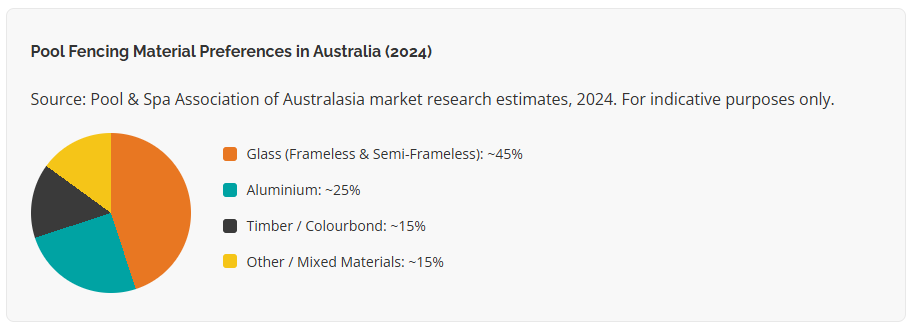
Data Disclaimer: The above chart reflects market estimates from industry association research. Figures are approximate and intended to illustrate general trends only.
New South Wales Pool Fence Regulations
In NSW, pool fencing is governed by the Swimming Pools Act 1992 and the Swimming Pools Regulation 2018. All pools must be registered on the NSW Swimming Pool Register. Pools built after August 1990 must have four-sided fencing isolating the pool from the house and neighbouring properties. Periodic compliance inspections apply, particularly on property sale, lease, or following a change of ownership.
Victoria Pool Fence Requirements
Victorian pool barriers fall under the Building Act 1993, Building Regulations 2018, and AS 1926.1-2012. As of November 2020, all swimming pools and spas in Victoria require compliant four-sided fencing regardless of construction date. Local councils conduct inspections and can issue fines for non-compliance. Gate requirements are particularly strict, including self-closing, self-latching mechanisms opening away from the pool.
Queensland Pool Safety Rules
Queensland’s Queensland Building and Construction Commission (QBCC) administers pool safety under the Building Act 1975. Pool safety certificates are mandatory on property sale or lease. Inspections must be conducted by a licensed pool safety inspector. Queensland enforces strict non-climbable zone requirements around fence perimeters.
Western Australia, South Australia, and Other States
Western Australia follows the Building Regulations 2012 under the Building Act 2011. South Australia mandates strict compliance with the Planning, Development and Infrastructure Act 2016 (SA) and Ministerial Building Standards. Tasmania, the ACT, and the Northern Territory each maintain similar frameworks aligned with the NCC. Regardless of state, the underlying technical standard is consistently AS 1926.1-2012 for pool barriers.
Height Requirements and Non-Climbable Zones in Australian Pool Fencing
Pool barrier height is one of the most commonly misunderstood compliance areas. The minimum height of 1,200mm (1.2 metres) is measured from the finished ground level on the outside of the fence to the top of the barrier. This measurement must be consistent along the entire perimeter, not just at the gate post.
Equally important is the non-climbable zone (NCZ). AS 1926.1-2012 defines a 900mm zone measured from the outside of the barrier, within which no footholds, handholds, or climbable objects should exist. Garden beds, furniture, storage containers, and even large potted plants can violate the NCZ if placed within this zone. During inspections, non-climbable zone breaches are among the most common compliance failures.
Key Height and Gap Rules Under AS 1926.1-2012:
Minimum barrier height: 1,200mm above finished ground level
Maximum gap under the fence: 100mm
Maximum gap between vertical members: 100mm
Non-climbable zone on exterior: 900mm from the barrier
Source: Standards Australia – AS 1926.1-2012
Glass pool fencing naturally satisfies many of these requirements. Solid glass panels provide no footholds or handholds along their surface. However, spigots and channel bases must be positioned and designed to avoid creating climbable features. A qualified pool safety inspector will check all of these elements during a compliance assessment.
Spigot vs Channel Mounting for a Glass Pool Fence: Understanding the Difference
The two primary mounting systems for frameless glass pool fencing are spigot mounting and channel (or shoe) mounting. Each has distinct structural characteristics, aesthetic outcomes, and site-suitability considerations.
Spigot Mounting Systems
Spigots are metal clamps drilled directly into concrete surrounds or embedded in concrete footings. Each spigot grips the bottom edge of the glass panel, holding it securely in a vertical position. The result is a visually clean installation where each panel appears to float above the surface. Spigots are the more popular choice for frameless installations around tiled or concrete pool edges in NSW. They require either a deep concrete foundation for core-drilled posts or reinforced timber joists for structural base-plated anchor systems.
Channel (Base Shoe) Mounting Systems
Channel mounting uses a continuous aluminium or stainless steel channel set into or onto the surface. Glass panels slot into the channel, which distributes load along the panel base rather than at discrete clamping points. Channel systems work particularly well on sloped ground, timber decks, or surfaces where drilling discrete spigot holes is impractical. They also allow slightly more flexibility during installation alignment.
Both systems deliver compliant, durable results when installed correctly. Your installer should recommend the appropriate system based on your pool surround material, ground conditions, and design goals. The experienced glaziers at Shine Glass assess each site individually before recommending a mounting approach.
Glass Pool Fencing Cost in Australia: What to Expect in 2026-2027
Cost is typically the first question homeowners ask. However, pricing for glass pool fencing varies widely based on panel dimensions, system type, gate requirements, site complexity, and regional labour rates. The following ranges are based on 2026-2027 industry data and represent fully installed costs.
Factors That Influence the Final Cost
- Pool perimeter length and panel count required
- Choice of frameless vs semi-frameless system
- Number and size of gates required
- Spigot vs channel mounting (channel often adds cost)
- Site accessibility and existing surface condition
- Glass tint or finish (clear, grey tint, bronze tint, acid-etched)
- Additional treatments such as EnduroShield or dedicated hydrophobic glass protection coatings
- State-based inspection fees and certification costs
While aluminium pool fencing costs less upfront, typically $80 to $180 per metre installed, glass delivers superior aesthetics, zero rust or rot, and minimal maintenance over its lifespan. Many homeowners who initially choose aluminium for budget reasons find they upgrade to glass within five years anyway. Therefore, the long-term cost calculation frequently favours glass from the outset.
You can also explore how glass balustrades around decks and alfresco areas complement pool fencing to create a cohesive outdoor living space, often reducing total project cost when scoped together.
What the Glass Pool Fence Installation Process Actually Looks Like
Understanding the installation process helps you prepare your site, ask better questions of your installer, and set realistic expectations for project timelines. A typical residential installation in NSW follows these steps.
Site Assessment and Measurement
The installer visits your property to measure the pool perimeter, assess ground conditions, identify gate positions, and determine the appropriate mounting system. Spigot positions or channel runs are marked.
Glass Panel Fabrication
Panels are custom cut to size and toughened at the factory. Toughening must happen before any drilling or notching, as toughened glass cannot be cut afterwards.
Spigot or Channel Installation
Spigots are drilled and fixed into concrete at precise intervals, or the channel base is secured to the surface. Correct alignment at this stage determines the final fence appearance.
Glass Panel Insertion and Alignment
Each toughened glass panel is carefully inserted into the spigots or channel, levelled, plumbed, and locked. Adjacent panels are aligned to maintain consistent gaps and heights.
Gate Installation and Hardware Fitting
Self-closing, self-latching gate hardware is installed and adjusted to ensure the gate closes and latches automatically from any open position, as required under AS 1926.1-2012, utilizing Grade A safety glass certified to AS/NZS 2208.
Final Inspection and Compliance Check
The installer conducts a final walk-around to verify heights, gaps, NCZ clearances, and gate function. Documentation for your pool safety inspection is then prepared.
A standard residential glass pool fence installation in NSW typically takes one to two days for supply and installation. However, site preparation, concrete curing periods for new footings, and council processing times can extend the full project timeline.
Pool Fence Inspection Checklist for Australian Homeowners
Before booking a formal compliance inspection, conduct your own pre-inspection walkthrough. This reduces the chance of a failed inspection and subsequent re-inspection fees. Here is what to check.
- Barrier height: Measure from outside ground level to top of glass. It must reach at least 1,200mm at all points.
- Gap under the fence: Confirm no gap exceeds 100mm between the glass base and ground.
- Gap between panels: Verify that no opening between panels exceeds 100mm.
- Non-climbable zone: Remove any furniture, garden features, or objects within 900mm of the outside fence face.
- Gate function: Test that the gate closes and latches automatically from any position without manual intervention.
- Gate latch height: Confirm the latch is positioned at least 1,500mm from the ground, or is on the pool side of the gate and shielded.
- Glass integrity: Check all panels for chips, cracks, or damage. Damaged panels must be replaced before inspection.
- Spigot or channel security: Ensure all fixings are tight and no panels wobble or shift under lateral pressure.
- Pool register: Confirm your pool is registered on the relevant state swimming pool register.
- Compliance certificate: Have your original installation compliance documentation ready.
Verified Fact – NSW Swimming Pool Register
In NSW, pools must be registered and inspected before a property can be sold or leased. Councils must inspect pools within specific timeframes. An inspection fee applies and a re-inspection fee is charged if the pool fails on the first visit.
Source: NSW Swimming Pool Register | NSW Swimming Pools Act 1992
Maintenance, Cleaning, and the Long-Term Durability of Glass Pool Fencing
One of the most common misconceptions about glass pool fencing is that it requires constant, difficult cleaning. In reality, maintenance is straightforward and infrequent compared to timber or steel alternatives that require regular painting, oiling, or rust treatment.
Routine Cleaning
A fortnightly rinse with fresh water removes most pool chemical residue, salt spray, and dust. For fingerprints and smudges, a microfibre cloth with a non-abrasive glass cleaner is sufficient. Avoid using steel wool, harsh scouring pads, or undiluted acidic cleaners, which can damage any protective coating on the glass surface.
Hard Water Mineral Deposits
In areas with hard tap water, calcium and magnesium deposits can build up on glass over time. These appear as white or cloudy patches, particularly near the base of panels. A diluted white vinegar solution (1 part vinegar to 3 parts water) applied with a soft cloth and rinsed promptly is effective for light mineral deposits. For stubborn scale, commercial pool glass restorers formulated for toughened safety glass are available from glazing supply specialists.
Protective Coatings
Many homeowners choose to apply a hydrophobic protective coating such as EnduroShield or a similar nano-coating to their glass panels at installation. These coatings cause water to bead and run off the surface, significantly reducing mineral deposit build-up and making routine cleaning even easier. The same principle applies to shower screens, where protective coatings are equally popular.
Spigot and Hardware Maintenance
Stainless steel or powder-coated spigots generally require minimal maintenance. However, coastal or high-humidity environments can cause some grades of stainless steel to develop surface rust staining. Using Duplex 2205 marine-grade stainless steel spigots and hardware around saltwater or chlorinated pools provides the necessary resistance against chemical corrosion and tea-staining. Check and tighten all hardware annually as part of your pool maintenance routine.
DIY vs Professional Glass Pool Fence Installation: An Honest Comparison
The appeal of DIY pool fence installation is understandable given that glass pool fencing cost per metre can seem significant. However, the practical and legal realities in Australia make professional installation the strongly recommended path for the vast majority of homeowners.
The Case for Professional Installation
Professional installers carry public liability insurance. They understand compliance requirements in your specific state and council area. They have the specialised equipment to safely handle 12mm toughened glass panels, which are extremely heavy and fragile before installation. Furthermore, most Australian states require that pool barriers pass a compliance inspection conducted by a licensed pool safety inspector. A professionally installed fence is far more likely to pass on the first inspection, saving re-inspection fees and delays.
What Can Go Wrong with DIY
Spigot drilling depth and spacing must be precisely calculated based on panel dimensions and load calculations. An incorrectly anchored spigot can allow a glass panel to become unstable or fail under lateral pressure. Additionally, panel misalignment can create gaps exceeding the 100mm maximum, resulting in immediate inspection failure. Toughened glass panels cannot be cut or modified on-site, so any incorrect measurement requires a costly panel replacement. The liability risk if a DIY-installed fence fails and a child is injured is also significant.
Verdict: While un-enclosed kit assembly may be permissible for minor repairs, NSW licensing laws mandate that structural pool barrier installations exceeding $5,000 must be completed by a licensed professional. Contact the team at Shine Glass for an expert assessment of your pool fencing project.
Shine Glass also installs complementary products including glass splashbacks and shower screens, making it practical to coordinate multiple glass projects across your home renovation under one trusted supplier.
Frequently Asked Questions About Glass Pool Fencing in Australia
How much does a glass pool fence cost?
As of 2026–2027, premium frameless glass pool fencing in Australia costs approximately $430 to $650+ per linear metre fully installed. Semi-frameless systems typically range from $300 to $450 per linear metre. A standard 15-metre perimeter with one gate may total $3,750 to $10,000 or more. Site conditions, glass finish, and regional labour rates all affect final pricing. Always request itemised quotes. Prices will change over time and the above ranges are indicative only.
Is glass pool fencing safe?
Yes. Compliant glass pool fencing uses Grade A toughened safety glass certified under AS/NZS 2208. It shatters into blunt fragments rather than sharp shards if broken. When professionally installed and regularly inspected, it is among the safest pool barrier options in Australia. Its visual transparency also allows continuous supervision of children near the water.
What are the rules for glass pool fences in Victoria?
In Victoria, pool barriers must comply with the Building Act 1993, Building Regulations 2018, and AS 1926.1-2012. The minimum barrier height is 1,200mm. Since November 2020, all pools and spas regardless of age require compliant four-sided fencing. Gates must be self-closing and self-latching. Local councils conduct inspections and can issue penalties for non-compliance.
How to install a glass pool fence?
Installation involves site measurement, custom panel fabrication, spigot or channel fixing into concrete, panel insertion and alignment, gate hardware fitting, and a final compliance check. Professional installation is strongly recommended due to the weight of toughened glass panels, structural anchoring requirements, and the need to pass a pool safety inspection in most Australian states.
Do you have to earth a glass pool fence?
Glass panels do not conduct electricity and do not require earthing. However, under AS/NZS 3000 (Clause 5.6.2.6), any conductive metal spigots or channels located within 2.4 metres of the pool water edge must undergo equipotential bonding by a licensed electrician. Consult a licensed electrician if your pool has electrical equipment near the fence line.
Is aluminium pool fencing cheaper than glass?
Yes. Aluminium typically costs $80 to $180 per linear metre installed, making it significantly cheaper upfront. However, aluminium can corrode in coastal environments, restricts pool visibility, and may require periodic repainting. Over a 20 to 30-year lifespan, glass often proves more cost-effective when maintenance is factored in. Prices are indicative for 2026-2027 and subject to change.
How thick does glass pool fencing need to be?
Under AS 1288, frameless glass pool fence panels must be a minimum of 12mm toughened safety glass. Semi-frameless systems may use 8mm to 10mm toughened glass depending on post spacing and the specific system’s certification. Confirm the thickness specification with your supplier before ordering panels.
Can I install my own pool fence?
Some DIY kit systems exist, but in most Australian states pool barriers must pass a compliance inspection by a licensed pool safety inspector. Incorrect installation can fail compliance, void home insurance, and create serious safety risks. Professional installation by a licensed glazier is the strongly recommended approach.
How hard is it to keep glass pool fencing clean?
Glass pool fencing is relatively easy to maintain. A fortnightly fresh water rinse removes most pool chemical residue. Fingerprints and smudges respond to a microfibre cloth and non-abrasive glass cleaner. Hard water mineral deposits respond to diluted white vinegar. Applying a hydrophobic protective coating at installation reduces the frequency of cleaning significantly.
Can you cut a glass pool fence?
No. Toughened safety glass cannot be cut, drilled, or modified after tempering. Any cutting must occur before the glass is toughened. Always provide accurate measurements to your glass supplier to ensure panels are fabricated to the correct dimensions. Ordering incorrectly sized panels requires full replacement.
What is the best material for a pool fence?
Glass is widely considered the best pool fencing material in Australia due to safety compliance, unobstructed supervision views, UV and chemical resistance, and long-term low maintenance. It suits all climates across Australia, from coastal NSW to inland Queensland. The aesthetic advantage over aluminium, timber, and steel also contributes to property value.
Does vinegar corrode glass?
Diluted white vinegar does not corrode toughened glass. It effectively dissolves calcium and mineral deposits on glass pool fencing. Use a 1 to 3 dilution with water, apply with a soft cloth, and rinse promptly. Avoid leaving undiluted or concentrated acidic solutions on glass surfaces for extended periods, as repeated exposure can affect any surface coating.
How long does a glass pool fence last?
A professionally installed, compliant glass pool fence typically lasts 20 to 30 years or more with basic maintenance. Toughened glass does not rust, rot, or fade under UV exposure. The primary maintenance items over this period involve hardware inspections and occasional gate adjustment rather than glass replacement.
Do glass pool fences need to be inspected?
Yes. Most Australian states require pool barriers to pass periodic compliance inspections by a registered pool safety inspector. In NSW, inspection is required on property sale or lease and councils conduct random inspections. The NSW Swimming Pool Register must list your pool. Failing to register or maintain compliance can result in fines.
What is the gap allowed under a glass pool fence?
Under AS 1926.1-2012, the maximum gap between the base of the pool barrier and the finished ground level is 100mm. This applies consistently along the entire fence perimeter. Gaps exceeding 100mm are a common inspection failure point and must be addressed before a compliance certificate can be issued.
What is a non-climbable zone around a pool fence?
A non-climbable zone (NCZ) is a 900mm area measured horizontally from the outside face of the pool barrier. Within this zone, no objects, structures, or landscaping features should provide a foothold or handhold that would allow a child to climb over the fence. Common NCZ violations include garden furniture, planter boxes, and retaining walls adjacent to the fence line.
Conclusion: Making the Right Decision About Your Glass Pool Fence
A glass pool fence represents the ideal intersection of safety, compliance, and visual design for Australian homeowners. Whether you choose a seamless frameless system on spigots or a budget-conscious semi-frameless installation with aluminium posts, the outcome is a barrier that protects the people you care most about without compromising the look and feel of your outdoor space.
The key decisions come down to system type, glass thickness, mounting method, and ensuring every aspect of the installation meets the requirements of AS 1926.1-2012 and your specific state regulations. Beyond the initial installation, maintenance is genuinely minimal. Furthermore, the long-term durability of toughened safety glass in Australian conditions means a compliant pool fence is an investment that delivers returns for decades.
Equally important is working with a qualified, experienced glazier who understands local compliance requirements. Across Sydney and NSW, Shine Glass delivers expert glass pool fencing supply and installation backed by practical site knowledge and a commitment to compliance. Their team also handles glass balustrades, shower screens, and glass splashbacks, making it straightforward to coordinate all glass work across your renovation project.
Finally, do not leave compliance to chance. Register your pool, understand your state requirements, conduct your own pre-inspection checks, and engage a licensed pool safety inspector when required. The cost of compliance is minor compared to the consequences of a preventable poolside tragedy.
